
15 Sep, 2026 | Stephanie Sanders | One Comment
Xanthan Gum: Helpful Tool or Hidden Concern?
A balanced look at the benefits, drawbacks, and digestive clues
By Stephanie Larmour Sanders, MS, RDN, CDE, FNLP
Clinical Dietitian, Certified Diabetes Educator, and Functional Nutritionist
Xanthan Gum: Helpful Tool or Hidden Concern?

Have you looked at the ingredient list in a baked good and wondered is this good or bad for me? I sure have.
Well Xanthan gum performs several useful functions in food, but individual digestive tolerance may vary.
Have you ever noticed xanthan gum on an ingredient label and wondered what it was—or whether you should avoid it?
You may find it in:
- Gluten-free bread and baked goods
- Salad dressings and sauces
- Soups and gravies
- Dairy alternatives
- Ice cream and frozen desserts
- Protein drinks and nutrition supplements
- Thickened liquids used for swallowing difficulties
The name may sound highly chemical, but xanthan gum is a carbohydrate produced through fermentation. It serves a practical purpose in food, and the small amounts normally consumed appear safe for most adults.
However, safe for the general population does not necessarily mean that every person will tolerate every amount.
Let’s examine the evidence without automatically placing xanthan gum in either the “good” or “bad” category.
What Is Xanthan Gum?
Xanthan gum—also identified as E415—is produced when the bacterium Xanthomonas campestris ferments a sugar source.
After fermentation, the xanthan gum is separated, purified, dried, and ground into a fine powder. The finished product does not contain active Xanthomonas bacteria.
When mixed with liquid, even a small quantity creates thickness and stability. It can keep ingredients suspended and prevent oil and water from separating.
The FDA permits xanthan gum for use as a food additive, including as a stabilizer, thickener, emulsifier and texturizer. The European Food Safety Authority has also concluded that its reported food uses do not pose a safety concern for the general population.
Why Is Xanthan Gum Used?
It improves gluten-free baking
Gluten normally helps dough stretch and hold together. When wheat is removed, gluten-free bread may become dry, crumbly or dense.
Xanthan gum helps bind the ingredients, retain moisture and create a more flexible texture. This can make gluten-free breads and baked goods easier to prepare and more enjoyable to eat.
It keeps products from separating
Xanthan gum helps stabilize salad dressings, sauces, plant-based beverages and other mixtures.
For example, it can help keep the oil and water in a salad dressing evenly distributed rather than quickly separating into two layers.
It thickens liquids
Xanthan-gum products are sometimes used to thicken liquids for people with dysphagia, or difficulty swallowing.
Clinical studies suggest that increasing liquid viscosity with a xanthan-based thickener can improve swallowing safety in some individuals. However, the correct consistency must be determined by a qualified healthcare professional—usually a speech-language pathologist. Adding extra thickener without professional guidance can make drinking more difficult and may contribute to inadequate fluid intake.
It may affect bowel function
Xanthan gum is not fully digested in the upper gastrointestinal tract. It reaches the colon, where certain intestinal microorganisms can ferment it.
In a small human study using much larger amounts than people normally obtain from food, xanthan gum increased stool output, bowel-movement frequency and gas. This suggests that it can act somewhat like a fermentable soluble fiber.
That effect may be useful for one person and uncomfortable for another.
Xanthan Gum: Pros and Cons
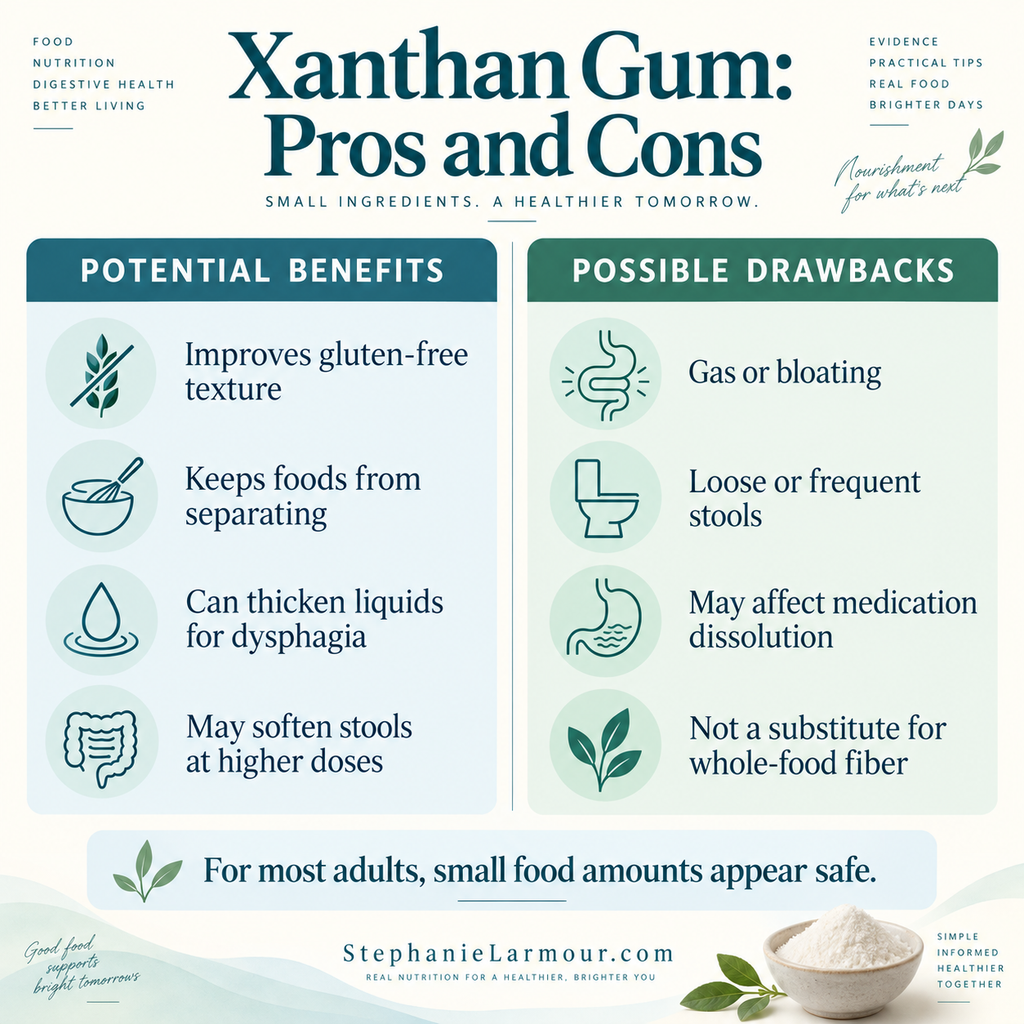
Xanthan gum has useful food and clinical applications, but higher amounts may cause digestive symptoms in sensitive individuals. Comparison infographic listing potential benefits and possible drawbacks of xanthan gum.
Potential Benefits of Xanthan Gum
1. It works in very small amounts.
Food manufacturers and home cooks generally need only a small amount to produce the desired texture.
2. It improves gluten-free food quality
For someone with celiac disease or another medical reason to avoid gluten, xanthan gum can make gluten-free foods less crumbly and more acceptable.
3. It may improve swallowing safety
When used correctly under professional supervision, xanthan-based thickeners can help selected patients control liquids more safely.
4. It may soften stools
Its ability to retain water and undergo fermentation may increase stool softness and frequency at higher intakes.
5. It may influence post-meal glucose
A few small studies suggest that xanthan gum’s viscosity may slow digestion and reduce the rise in blood glucose after certain meals.This is interesting, but the research is not strong enough to recommend xanthan gum as a treatment for diabetes.
Whole foods, dietary patterns, movement, sleep, medication when needed, and individualized medical nutrition therapy remain much more important.
Possible Drawbacks
1. Gas and bloating
Because intestinal organisms can ferment xanthan gum, some people may experience:
- Gas
- Bloating
- Abdominal pressure
- Cramping
- Changes in bowel habits
These reactions are more likely with larger quantities, but people with sensitive digestive systems may notice symptoms at lower amounts.
2. Loose or more frequent stools
Higher intakes may have a laxative effect. Someone already experiencing diarrhea, urgency or an irritable bowel may not tolerate concentrated amounts well. The quantities used in studies showing strong laxative effects were generally much greater than those found in an ordinary serving of food.
3. Microbiome changes
Research has found that certain intestinal bacteria can break down xanthan gum. Therefore, xanthan gum may influence the microbial community in the colon. That does not automatically mean the change is beneficial or harmful.
Animal and laboratory studies have raised questions about whether chronic exposure could affect the intestinal environment. However, we do not currently have strong human evidence showing that the small amounts used in food cause chronic intestinal inflammation, inflammatory bowel disease or a “leaky gut.”
This is an area where the evidence should continue to be monitored.
4. It is not equivalent to whole-food fiber
Although xanthan gum behaves like a fermentable fiber, it does not offer the full nutritional benefits of:
- Vegetables
- Fruit
- Beans and lentils
- Nuts and seeds
- Intact whole grains
These foods provide multiple types of fiber along with vitamins, minerals and protective plant compounds. Xanthan gum should not be promoted as a replacement for a varied, fiber-rich diet.
5. Thickened fluids can affect medications
A thickened liquid may change how quickly certain tablets or capsules break apart and dissolve. Anyone who requires thickened liquids should ask a pharmacist how each medication should be administered. Medications should not automatically be crushed or mixed into a thickened drink.
Does Xanthan Gum Cause Inflammation?
At this time, there is insufficient human evidence to conclude that normal dietary amounts of xanthan gum cause systemic or chronic intestinal inflammation.
This distinction is important:
- Fermentation is not automatically inflammation.
- A microbiome change is not automatically damage.
- Digestive discomfort is not automatically an allergy.
- An animal finding is not proof of the same outcome in people.
However, individual symptoms still matter. If a person repeatedly develops bloating, abdominal pain or diarrhea after eating products containing xanthan gum, that pattern deserves investigation.
The goal is not to dismiss the symptom—but it is also not to make a universal safety conclusion from one person’s response.
What About Xanthan Gum and Food Allergies?
A true allergy to xanthan gum appears to be uncommon. Digestive symptoms such as gas and bloating are more likely to reflect intolerance or fermentation than an allergic response.
Signs of a potentially serious allergic reaction include:
- Hives
- Swelling of the lips, tongue or throat
- Wheezing
- Difficulty breathing
- Dizziness or fainting
These symptoms require immediate medical attention. Xanthan gum may be produced using sugars derived from different sources. However, the fermentation product undergoes purification. Someone with a severe allergy who is concerned about a particular product should contact the manufacturer for its allergen-control information rather than assuming that every xanthan-gum product contains the original source protein.
An Important Infant Precaution
Xanthan-gum thickening products have been associated with reports of necrotizing enterocolitis, a serious intestinal disorder, in premature infants. This concern should not be applied directly to ordinary adult food exposure. Premature infants have uniquely vulnerable and still-developing digestive systems.
Nevertheless, parents and caregivers should never add xanthan gum or another commercial thickener to an infant’s feeding unless directed by the infant’s physician and clinical feeding team.
How to Investigate Your Own Response
If you think xanthan gum may be affecting you, begin by gathering clues.
Ask yourself:
- What food did I eat?
- Approximately how much did I eat?
- Was xanthan gum near the beginning or end of the ingredient list?
- What other gums, sweeteners or fermentable carbohydrates were present?
- When did my symptoms begin?
- Did the same reaction occur more than once?
- Do I react to every product containing xanthan gum—or only one particular food?
A packaged food may contain several possible digestive triggers, including:
- Inulin or chicory-root fiber
- Sugar alcohols
- Lactose
- Large amounts of fat
- Guar gum or other gum
- Artificial or natural sweeteners
- Large quantities of added fiber
Xanthan gum may be the cause, one contributing factor, or simply one ingredient on a much longer list.
A Simple Food Detective Experiment
If symptoms are mild and there is no history of a severe allergic reaction:
- Record the food, quantity and symptoms.
- Avoid the suspected product for a brief, defined period.
- Keep the rest of the diet reasonably consistent.
- Reintroduce the food under similar circumstances.
- Observe whether the same symptoms return.
Do not eliminate numerous foods indefinitely based on one uncomfortable experience. Extensive restriction can reduce dietary variety and make it harder to identify the true cause. People with severe symptoms, unintended weight loss, blood in the stool, persistent diarrhea, difficulty swallowing or a history of anaphylaxis should seek professional medical evaluation rather than perform an unsupervised food challenge.
Individual symptoms are meaningful clues, but they do not prove that an ingredient is harmful for everyone.
Individual symptoms are meaningful clues, but they do not prove that an ingredient is harmful for everyone.

Ask:
- How much did I eat?
- How often did I eat it?
- What other ingredients were present?
- Did the symptom occur more than once?
Your response is a clue—not proof that the ingredient is dangerous for everyone.Step back. Look for patterns. Ask better questions. One clue at a time.
The Bottom Line
Xanthan gum has legitimate food and clinical uses. It improves gluten-free baking, keeps products stable and can help create prescribed liquid consistencies for people with swallowing disorders. Current safety reviews indicate that normal food use is not a concern for most adults. Larger amounts can cause gas, bloating and changes in bowel habits, and individual tolerance varies.
There is not enough human evidence to claim that ordinary consumption causes chronic inflammation or damages everyone’s gut.
The most useful approach is not fear or automatic avoidance. It is observing your symptoms, considering the complete food, and looking for a reproducible pattern.
References
- U.S. Food and Drug Administration. Understanding How the FDA Regulates Food Additives and GRAS Ingredients.
- European Food Safety Authority. Re-evaluation of Xanthan Gum (E415) as a Food Additive. EFSA Journal. 2017.
- Daly J, Tomlin J, Read NW. The Effect of Feeding Xanthan Gum on Colonic Function in Man. British Journal of Nutrition. 1993.
- Bolívar-Prados M, et al. Effect of a Gum-Based Thickener on the Safety of Swallowing. 2019.
- Centers for Disease Control and Prevention. FDA Advisory Regarding a Xanthan-Gum Thickening Product and Premature Infants.
Stephanie
If you want to be invited to my private membership page. Please send your email to StephanieLarmourSanders@gmail.com