12 Aug, 2026 | Stephanie Sanders | No Comments
Perimenopause, Inflammation, and Metabolic Health: Why Hormones Are Only Part of the Story(article 2 of 3)
Stephanie Larmour Sanders, MS, RDN, CDE, FNLP
Clinical Dietitian, Certified Diabetes Educator, and Functional Nutritionist
If you read Article 1, you learned that perimenopause is a natural hormonal transition—and that estrogen and progesterone do not simply decline in a predictable straight line.
They fluctuate.
That can help explain why one month may feel very different from the next.
But hormones are only one part of what is happening during midlife.
Sleep may change. Stress may increase. Muscle mass and body composition can shift. Blood sugar regulation and cardiovascular risk become increasingly important. And some women begin noticing fatigue, cravings, brain fog, mood changes, or changes in where their bodies store fat.
It is tempting to put all of these experiences into one bucket and call them “hormonal.”
I think we can ask a better question:
What is changing—and what patterns might those changes reveal?
Perimenopause happens within a whole person. Hormones interact with metabolism, sleep, stress, nutrition, physical activity, muscle, medical conditions, and the immune system.
That is where an anti-inflammatory approach can be helpful—not as a way to “cure” perimenopause, but as a framework for identifying modifiable factors that may support health during this transition.
THE MIDLIFE CONNECTION
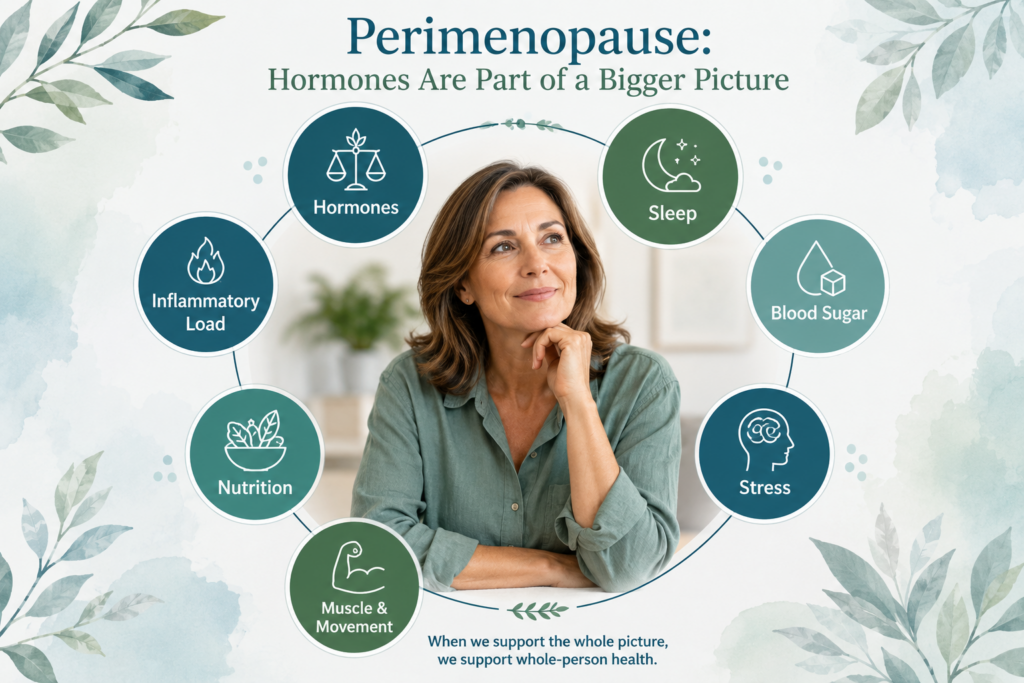
Perimenopause: Hormones Are Part of a Bigger Picture
Hormonal changes during perimenopause interact with many other aspects of health.
Hormones Are Changing—But They Are Not Acting Alone
During perimenopause, ovarian function becomes less predictable.
Estrogen may rise and fall considerably, while ovulation becomes less consistent and progesterone production changes.
These changes can contribute to recognized perimenopausal symptoms such as:
🟢 Changes in menstrual cycles
🔵 Hot flashes and night sweats
🟢 Sleep disruption
🔵 Vaginal and urinary symptoms
🟢 Mood changes
But symptoms such as fatigue, poor concentration, weight changes, sleep problems, anxiety, or low energy are more complicated.
Why?
Because many things can produce similar symptoms.
Iron deficiency, thyroid disease, diabetes or prediabetes, sleep apnea, depression, anxiety, medication effects, inadequate nutrition, chronic stress, and other medical conditions can overlap with perimenopause.
That is why I don’t want women to hear:
“You’re in your 40s. It’s just your hormones.”
Your symptoms deserve more curiosity than that.
🌿 STEPHANIE SAYS
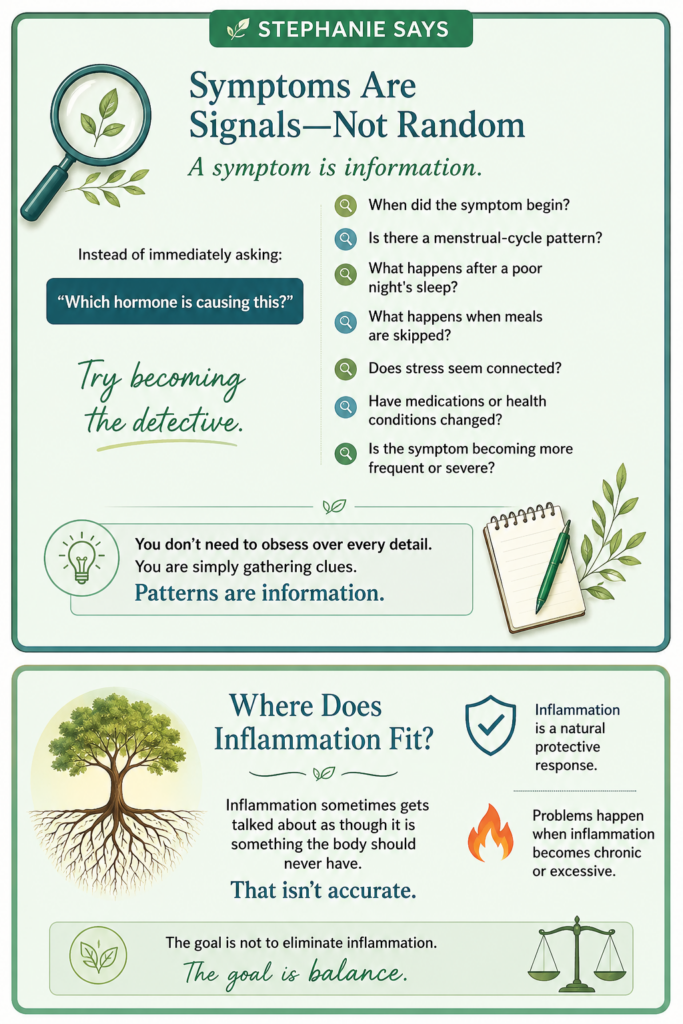
A symptom is information.
Instead of immediately asking:
“Which hormone is causing this?”
You are simply gathering clues.
Patterns are information.
Where Does Inflammation Fit?
Inflammation sometimes gets talked about as though it is something the body should never have.
That isn’t accurate.
Inflammation is an essential part of immune defense, tissue repair, and healing.
The concern is persistent, poorly regulated, low-grade inflammatory activity, particularly when it occurs alongside conditions such as metabolic disease or other chronic health problems.
Estrogen interacts with immune and inflammatory pathways, and researchers continue to investigate how the menopause transition may influence inflammatory markers and cardiometabolic health.
However, we need an important evidence boundary here:
Perimenopause should not simply be described as an inflammatory disease.
And an inflammatory marker cannot tell us why a woman is experiencing every symptom.
Instead, I find it more helpful to think about inflammatory load.
Several factors may accumulate:
🔵 Poor or inadequate sleep
🟢 Smoking
🔵 Low physical activity
🟢 Metabolic disease
🔵 Chronic psychological stress
🟢 Poor overall diet quality
🔵 Excess visceral adiposity
🟢 Certain medical conditions
Hormonal changes occur within that environment.
The goal is not to eliminate all inflammation.
The goal is to identify and reduce avoidable inflammatory load while supporting overall health.
THE INFLAMMATION TREE: MIDLIFE EDITION
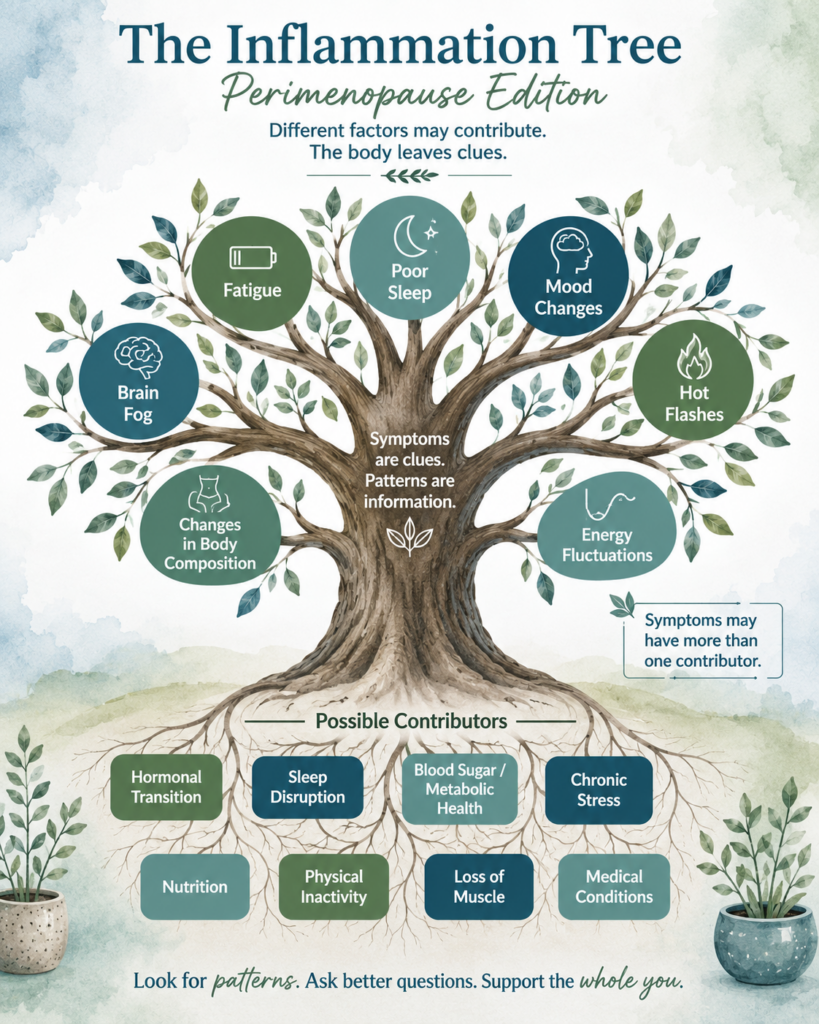
ROOTS — possible contributors
- Hormonal transition
- Sleep disruption
- Blood sugar/metabolic health
- Chronic stress
- Nutrition
- Physical inactivity
- Loss of muscle
- Medical conditions
BRANCHES — possible clues
- Fatigue
- Poor sleep
- Mood changes
- Brain fog
- Hot flashes
- Changes in body composition
- Energy fluctuations
- Hormonal changes may be one contributor within a larger pattern of metabolic, lifestyle, and health influences.
Insulin Is a Hormone Too
When we talk about hormones during perimenopause, estrogen tends to receive most of the attention.
But there is another hormone I don’t want you to forget:
Insulin.
Insulin helps glucose move from the bloodstream into cells, where it can be used for energy or stored.
Blood sugar regulation is affected by much more than carbohydrate alone.
It may be influenced by:
🟢 Food
The amount and type of carbohydrate matter, but so do protein, fiber, fat, meal composition, and meal timing.
🔵 Muscle
Skeletal muscle is an important site for glucose disposal. Maintaining and building muscle therefore becomes particularly valuable as we age.
🟢 Movement
Physical activity can support insulin sensitivity and metabolic health.
🔵 Sleep
Insufficient or disrupted sleep can influence appetite, glucose regulation, mood, and energy.
🟢 Stress
The stress response affects energy regulation and can also change sleep, eating behavior, and physical activity.
These factors do not operate independently. They interact.
The Blood Sugar Roller Coaster
Imagine you have been awake several times overnight because of hot flashes.
Morning arrives and you’re exhausted.
Breakfast is coffee and a pastry because you’re rushing.
A few hours later, you’re hungry again.
By mid-afternoon you feel tired and foggy, and something sweet sounds wonderful.
By evening, you may be wondering:
“Why don’t I have more willpower?”
But I don’t think willpower is the most useful question.
Instead ask:
🔎 Did I sleep?
🔎 Was breakfast satisfying?
🔎 Did my meal contain protein and fiber?
🔎 Did I go too long without eating?
🔎 How stressed was I?
🔎 Did I move today?
That changes the conversation from blame to investigation.
The body leaves clues.
THE MIDLIFE BLOOD SUGAR ROLLER COASTER
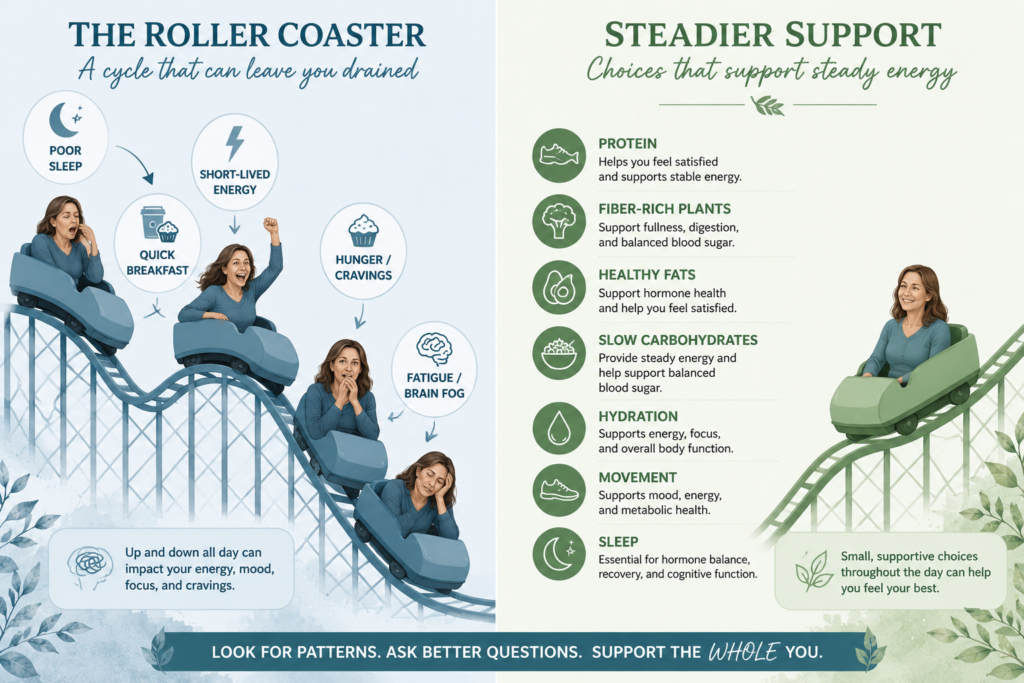
LEFT — THE ROLLER COASTER
Poor sleep → quick breakfast → short-lived energy → hunger/cravings → fatigue/brain fog
RIGHT — STEADIER SUPPORT
Show:
🟢 Protein
🟢 Fiber-rich plants
🟢 Healthy fats
🟢 Slow carbohydrates
🟢 Hydration
🟢 Movement
🟢 Sleep
Look for patterns—not perfection.
Food, sleep, stress, muscle, and movement can all influence energy and blood sugar patterns.
Blood sugar roller-coaster graphic comparing rapid energy fluctuations with steadier support from balanced meals, hydration, movement, and sleep.
Sleep Is Part of the Picture
Sleep disruption is common during the menopause transition.
For some women, the connection is obvious.
You wake drenched from a night sweat, throw off the covers, cool down—and then struggle to fall asleep again.
But hormones aren’t the only possible contributor to poor sleep.
Sleep may also be affected by:
🔵 Stress and anxiety
🟢 Alcohol
🔵 Caffeine
🟢 Chronic pain
🔵 Medications
🟢 Restless legs
🔵 Sleep apnea
🟢 Depression or other health conditions
That is why chronic exhaustion shouldn’t automatically be dismissed as menopause.
Persistent snoring, gasping during sleep, significant daytime sleepiness, morning headaches, or sleep problems that substantially interfere with daily life deserve medical evaluation.
Sleep is not a luxury.
It is part of metabolic, cognitive, emotional, and overall health.
Cortisol Is Not the Enemy
Cortisol has developed a bad reputation in wellness culture.
But cortisol isn’t a toxin.
It is an essential hormone involved in the body’s stress response, metabolism, blood pressure regulation, immune activity, and energy availability.
The goal isn’t to eliminate cortisol.
A better question is:
Does your body have enough opportunity to recover from repeated stress?
Midlife may include careers, caregiving, aging parents, financial pressures, relationship changes, children leaving home, health concerns—and hormonal changes—all at the same time.
Telling a woman to simply “lower her cortisol” misses that complexity.
Instead, look for opportunities to reduce unnecessary load and create realistic recovery.
That might be five quiet minutes.
A walk.
Turning off work earlier.
Asking for help.
Going to bed rather than finishing one more task.
Rest is a health practice—not something you have to earn.
Why Muscle Deserves More Attention
Many women enter perimenopause focused almost entirely on weight.
I would like to broaden that conversation.
Muscle matters.
Muscle supports:
🟢 Strength
🔵 Mobility
🟢 Glucose metabolism
🔵 Balance
🟢 Physical function
🔵 Independence as we age
Resistance exercise becomes especially valuable in midlife.
That does not mean everyone needs to join a gym or lift heavy weights.
Depending on your health and ability, strength-supportive movement might include resistance bands, weights, body-weight exercises, gardening, carrying groceries, climbing stairs, or professionally guided exercise.
The important message is:
Movement is support, not punishment.
Exercise is not something you owe your body because you ate.
It is something you can offer your body because you want it to remain strong.
What About Body Composition?
Changes in body composition and fat distribution may occur across the menopause transition.
Some women notice more abdominal fat even when the number on the scale has not changed dramatically.
But body composition is influenced by more than estrogen alone.
Age, genetics, muscle mass, sleep, physical activity, dietary patterns, medications, metabolic health, and other factors can contribute.
This is another place where blame is unhelpful.
Instead of asking only:
“How do I stop gaining weight?”
Consider broadening the goal:
How can I support muscle, metabolic health, cardiovascular health, nourishment, sleep, and physical function during this stage of life?
That is a much richer health conversation than a number on the scale.
🔬 RESEARCH SNAPSHOT
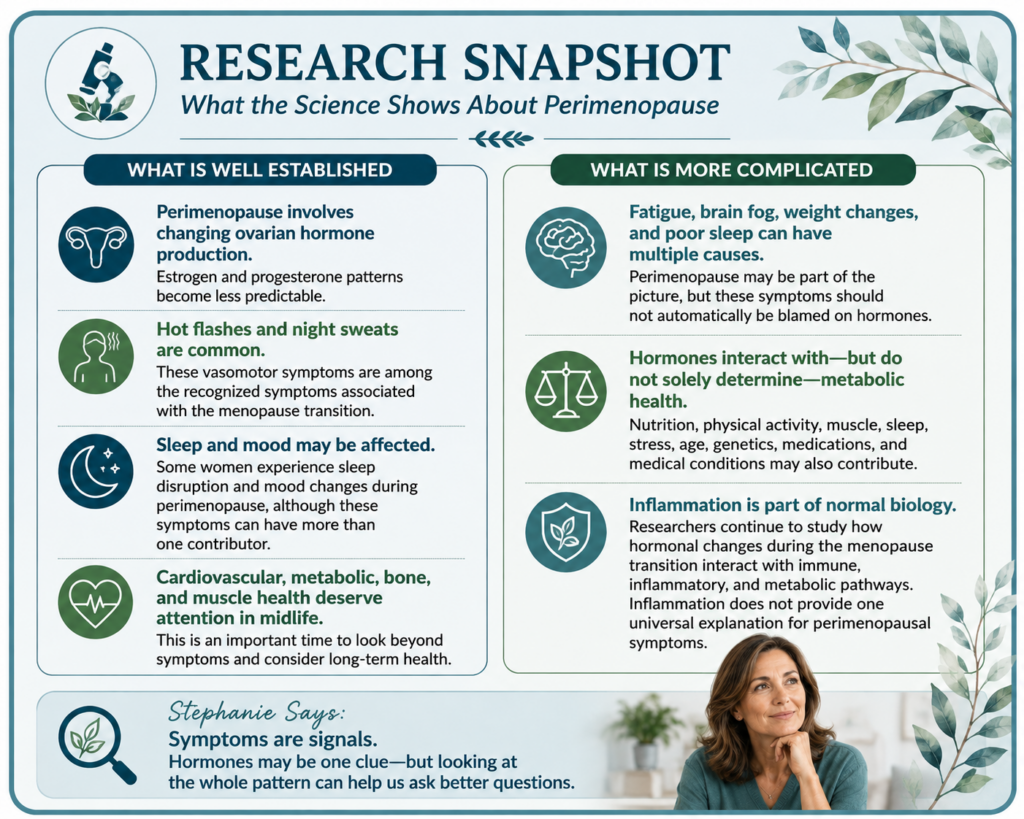
What is well established?
🔵 Perimenopause involves changing ovarian hormone production.
🟢 Vasomotor symptoms such as hot flashes and night sweats are common.
🔵 Sleep and mood may be affected during the menopause transition.
🟢 Cardiovascular, metabolic, bone, and muscle health deserve attention in midlife.
What is more complicated?
🔵 Fatigue, brain fog, weight changes, and poor sleep can have multiple causes.
🟢 Hormones interact with—but do not solely determine—metabolic health.
🔵 Inflammation is involved in many biological processes, but it does not provide one universal explanation for perimenopausal symptoms.
What should make you cautious?
Be skeptical of claims that:
❌ One hormone test identifies the cause of every symptom.
❌ One supplement “balances” everyone’s hormones.
❌ A detox removes the cause of menopause symptoms.
❌ One restrictive diet is necessary for every woman.
More testing and more supplements do not automatically mean better care.
Supporting the Whole Person
An anti-inflammatory lifestyle is not about trying to reverse perimenopause.
Perimenopause is a normal life transition.
Instead, we can support the systems affected by—and interacting with—that transition.
Start with foundations.
MIDLIFE SUPPORT FOUNDATIONS
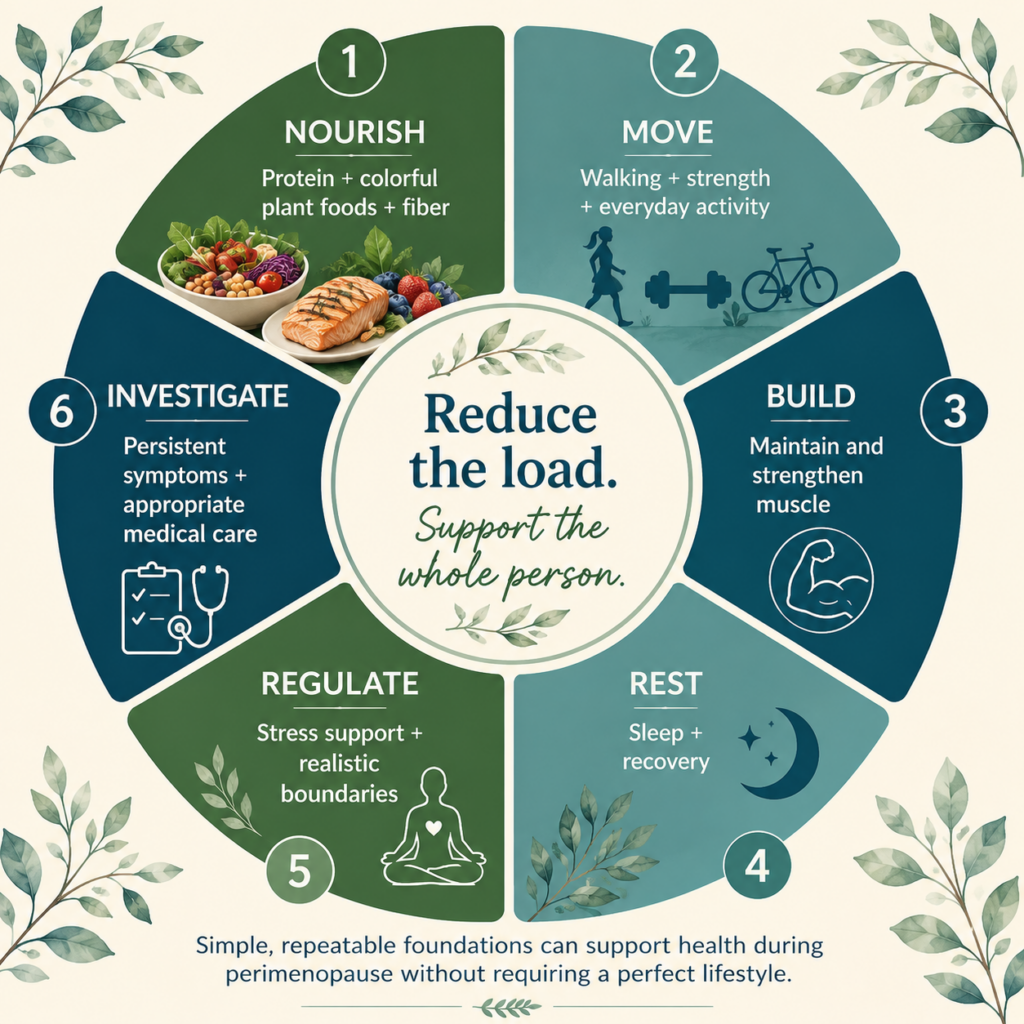
Simple, repeatable foundations can support health during perimenopause without requiring a perfect lifestyle.
Six-part midlife health graphic showing nourishing food, movement, muscle, sleep, stress support, and appropriate medical evaluation.
Start With One Meal
You do not need a “menopause diet.”
Begin by strengthening one meal you already eat.
Try combining:
🟢 Protein: fish, eggs, poultry, Greek yogurt, cottage cheese, tofu, tempeh, beans, or lentils.
🔵 Fiber-rich plants: vegetables, fruit, beans, lentils, whole grains, nuts, or seeds as appropriate for you.
🟢 Healthy fats: olive oil, avocado, nuts, seeds, or oily fish.
🔵 Slow carbohydrates: beans, lentils, oats, barley, quinoa, brown rice, sweet potato, or other minimally processed carbohydrate foods.
No food has to perform magic.
The value comes from the overall pattern.
What Should You Track?
You don’t need an elaborate spreadsheet.
For one week, simply notice:
🟢 Symptoms — hot flashes, headaches, mood changes, fatigue, cravings, brain fog, digestive changes.
🔵 Menstrual patterns — timing, duration, and unusual bleeding.
🟢 Sleep — approximate duration and awakenings.
🔵 Meals — meal timing and whether meals contained protein and fiber.
🟢 Energy — when do you feel strongest and when do you crash?
🔵 Stress — what was happening on particularly difficult days?
The purpose is not to achieve a perfect score.
It is to identify patterns you can discuss with your healthcare professional or use to choose a realistic next step.
When Should You Seek Medical Care?
Perimenopause is normal.
That doesn’t mean every symptom should simply be tolerated.
Talk with your healthcare professional about:
🔵 Very heavy menstrual bleeding
🟢 Bleeding or spotting between periods
🔵 Bleeding after sex
🟢 Menstrual bleeding that has changed substantially from your usual pattern
🔵 Persistent or severe mood symptoms
🟢 Significant or unexplained fatigue
🔵 Symptoms that substantially interfere with sleep, work, relationships, or daily life
🟢 Possible signs of thyroid disease, diabetes, anemia, sleep apnea, or another medical condition
🔵 Menopause-type symptoms occurring unexpectedly early
Seek urgent medical care for severe chest pain, significant shortness of breath, fainting, stroke symptoms, or thoughts of self-harm.
The Bottom Line
Perimenopause is hormonal.
But you are more than your hormones.
Sleep matters.
Blood sugar and metabolic health matter.
Muscle matters.
Nutrition matters.
Movement matters.
Stress and recovery matter.
And medical history matters.
An anti-inflammatory approach does not promise to “fix your hormones.”
It helps us look at the larger picture and ask:
Where can we reduce unnecessary inflammatory load and strengthen the foundations that support health?
You don’t have to change everything.
Choose one place to begin.
Strengthen breakfast.
Take a walk.
Protect your sleep.
Build some muscle.
Track a symptom.
Or make the medical appointment you’ve been postponing.
Small actions give us information.
And information helps us decide what comes next.
Symptoms are signals. Patterns are information. Better questions can lead to better care.
Coming Next — Article 3
Supporting Your Body Through Perimenopause: A Practical Anti-Inflammatory Approach
Article 1 helped you understand the hormonal transition.
Article 2 connected those hormonal changes with the bigger picture—blood sugar, sleep, stress, muscle, metabolic health, and inflammatory load.
In Article 3, we’ll turn that understanding into a practical plan.
We’ll explore:
🟢 How to build an anti-inflammatory plate
🔵 Protein needs and muscle support
🟢 Fiber and colorful plant foods
🔵 Healthy fats
🟢 Strength and everyday movement
🔵 Sleep and recovery
🟢 Supplements—what deserves caution
🔵 Medical treatment and when to discuss options with your healthcare professional
Previous article:
Perimenopause: Understanding the Hormonal Transition
[ ARTICLE 1 Stephanielarmour.com]
Next article:
Supporting Your Body Through Perimenopause: A Practical Anti-Inflammatory Approach
[ ARTICLE 3 Stephanielarmour.com]
Evidence Boundaries
ESTABLISHED
Perimenopause involves changing ovarian hormone production and may cause menstrual changes, vasomotor symptoms, and other recognized menopausal symptoms.
MULTIFACTORIAL
Sleep, mood, metabolic health, body composition, physical activity, nutrition, muscle, stress, age, genetics, medications, and medical conditions may all influence a woman’s midlife health experience.
EMERGING
Research continues into the relationships among menopause, inflammatory biomarkers, the microbiome, metabolic pathways, and long-term health outcomes.
NOT ESTABLISHED
There is no single hormone test, inflammation marker, supplement, detox, commercial test, or diet that can identify and correct the cause of every perimenopausal symptom.
Lifestyle strategies can support health, but they should not replace appropriate medical evaluation or evidence-based treatment.
References
- American College of Obstetricians and Gynecologists (ACOG). The Menopause Years.
- American College of Obstetricians and Gynecologists (ACOG). Hormone Therapy for Menopause.
- The Menopause Society. Patient and clinician resources on perimenopause, menopause symptoms, and treatment.
- National Institute on Aging. What Is Menopause?
- U.S. Department of Health and Human Services, Office on Women’s Health. Menopause.
- World Health Organization. Menopause.
Write Reviews
Leave a Comment
No Comments & Reviews