
12 Oct, 2026 | Stephanie Sanders | No Comments
Why Am I Still Tired? Becoming the Detective of Fragmented Sleep
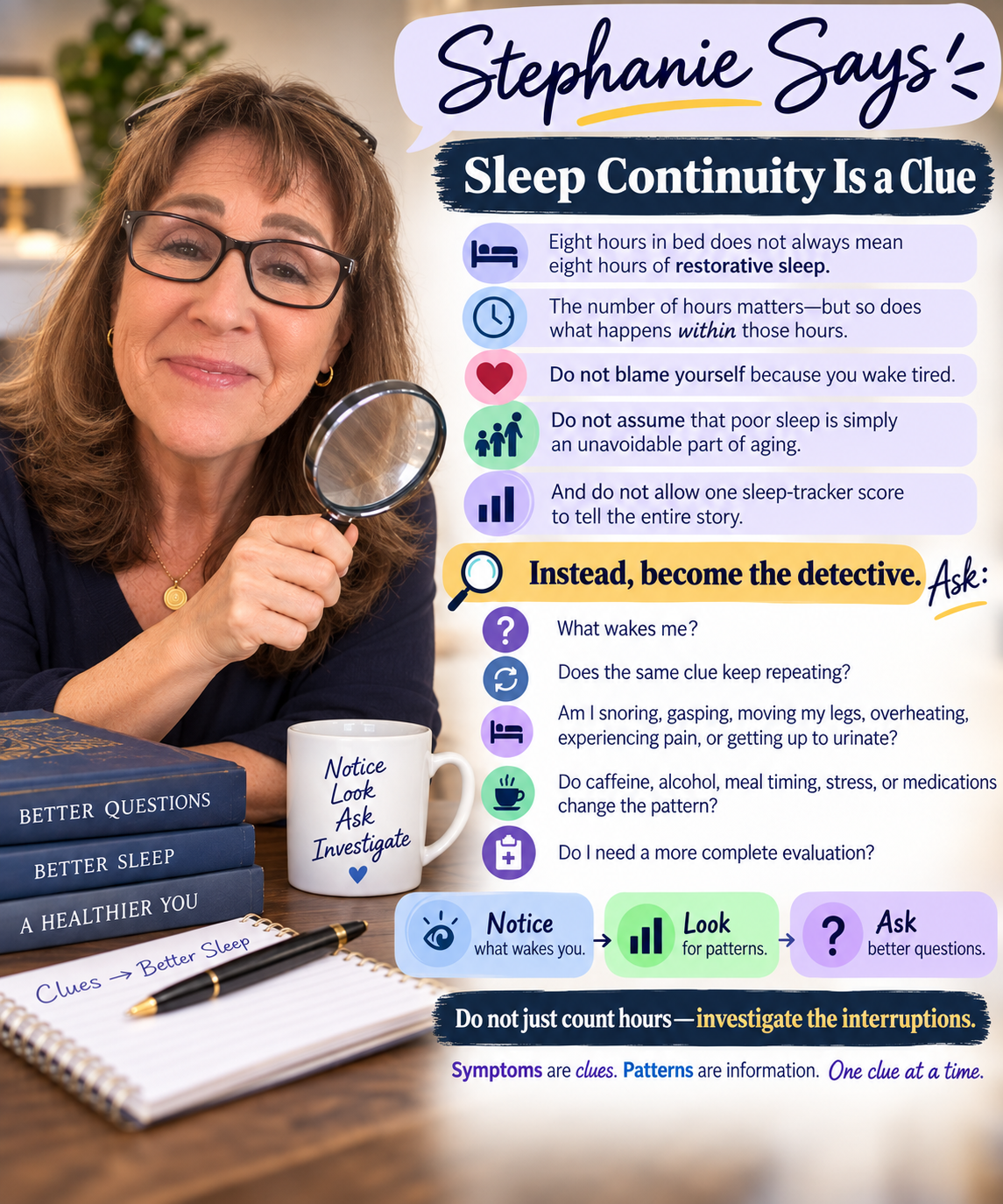
Article 3 of 3 in the Sleep Detective Series
Stephanie Larmour Sanders, MS, RDN, CDE, FNLP
Clinical Dietitian, Certified Diabetes Educator, and Functional Nutritionist
Stephanie’s Review
In Article 1, we explored sleep architecture—the repeating sequence of N1, N2, N3, and REM sleep.
We learned that:
- N1 opens the door to sleep.
- N2 helps maintain sleep and process information.
- Deep N3 sleep supports physical restoration.
- REM sleep supports memory, learning, and emotional processing.
- The early night contains more deep sleep.
- The later night contains longer REM periods.
- The brain needs the entire sequence.
In Article 2, we investigated deep sleep and the glymphatic system.
Human research shows that NREM sleep is associated with coordinated changes in brain activity, cerebral blood volume, and cerebrospinal-fluid movement.[1]
However, the phrase “brain detox” oversimplifies a complex and evolving area of research. Fluid movement is real, but researchers are still determining exactly how much metabolic waste is removed from the human brain during sleep.
This brings us to the next clue:
What happens when something repeatedly interrupts the normal sleep sequence?
Why Am I Still Tired?
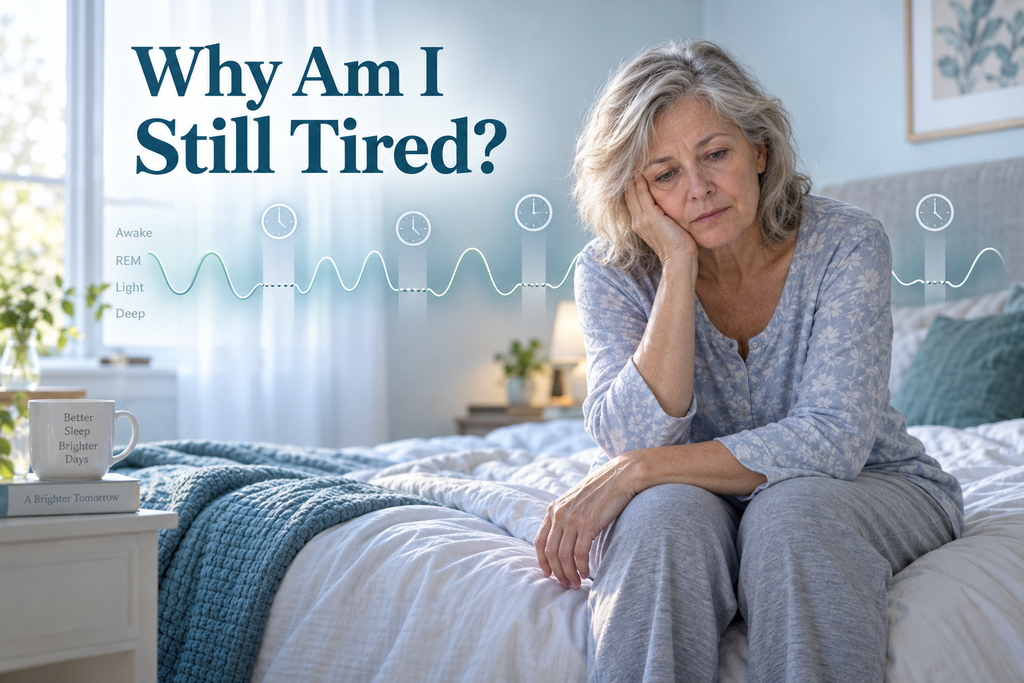
Time in bed does not always equal restorative sleep. Repeated awakenings may interrupt the brain’s normal progression through sleep stages.
woman sitting on the edge of her bed in the morning beside symbols of repeated nighttime awakenings.
Eight Hours in Bed Does Not Always Mean Eight Hours of Restorative Sleep
Someone may go to bed at 10 PM, get out of bed at 6 AM, and assume they obtained eight hours of restorative sleep. But time in bed and time asleep are not the same.Sleep can be interrupted by brief awakenings that a person remembers—or by short arousals that the person never consciously notices.
These interruptions may be associated with:
- Changes in breathing
- Leg movements
- Pain
- Temperature changes
- Reflux
- The need to urinate
- Environmental noise
- Alcohol
- Medications
- Stress-system activation
Even when the total number of hours looks adequate, disrupted sleep may leave someone feeling:
- Tired
- Mentally foggy
- Irritable
- Unrefreshed
- Less focused
- Physically heavy
- Sleepy during the day
This is why sleep continuity is an important clue.
What Is Sleep Fragmentation?
Sleep fragmentation occurs when sleep is repeatedly interrupted by arousals or awakenings.
Some awakenings are normal.
Most people briefly awaken between sleep cycles or while changing position. These awakenings may be so short that they are not remembered in the morning.
Fragmentation becomes more concerning when awakenings are:
- Frequent
- Prolonged
- Associated with breathing changes
- Caused by recurring physical symptoms
- Followed by difficulty returning to sleep
- Associated with daytime fatigue or sleepiness
When the brain is repeatedly aroused, it may move from deeper sleep back into lighter sleep or wakefulness.
This may interfere with the normal progression through:
N1 → N2 → N3 → REM
The person may technically be asleep for much of the night while still experiencing disrupted sleep architecture.
What May Be Interrupting Your Sleep?
Sleep fragmentation is not one diagnosis. It is a pattern that may have many possible causes. The goal is not to guess. The goal is to identify the repeating clues and determine which ones deserve further evaluation.
What May Be Interrupting Your Sleep?
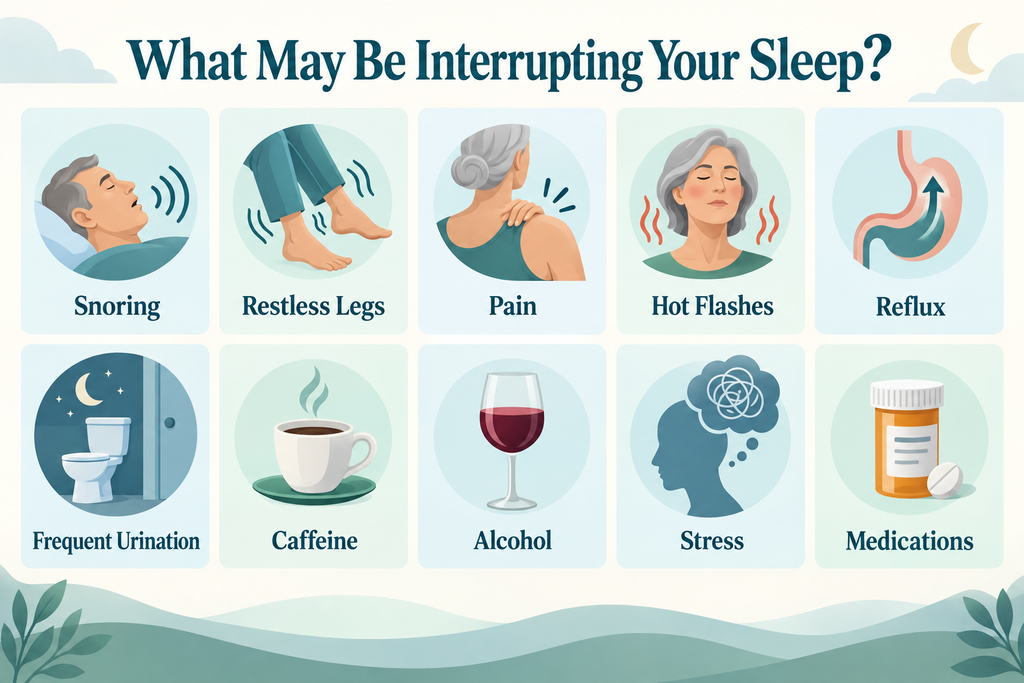
Snoring, restless legs, pain, hot flashes, reflux, frequent urination, caffeine, alcohol, stress, and medications can all provide clues about fragmented sleep.
Clue 1: Snoring, Gasping, or Pauses in Breathing
Obstructive sleep apnea occurs when the upper airway repeatedly narrows or closes during sleep. When breathing decreases or stops, oxygen levels may fall and the brain may briefly arouse the person enough to reopen the airway.
These arousals may happen repeatedly without the person remembering them.
Possible clues include:
- Loud, frequent snoring
- Breathing that stops and restarts
- Gasping or choking during sleep
- Dry mouth in the morning
- Morning headaches
- Frequent nighttime urination
- Daytime fatigue
- Excessive sleepiness
- Difficulty concentrating
- Insomnia or frequent awakenings
Women may not always report the “classic” picture of loud snoring and obvious daytime sleepiness. Fatigue, headache, insomnia, and mood or concentration changes may also be part of the presentation.[2,3]
A sleep study may be needed to determine whether sleep apnea is present and how severe it is. Sleep apnea cannot be diagnosed from snoring alone, a smartwatch, or a questionnaire.
Clue 2: Restless Legs and Periodic Limb Movements
Restless legs syndrome and periodic limb movements are related, but they are not identical.
Restless Legs Syndrome
Restless legs syndrome commonly involves:
- An urge to move the legs
- Crawling, pulling, tingling, aching, or uncomfortable sensations
- Symptoms that begin or worsen during rest
- Symptoms that become more noticeable in the evening or at night
- Temporary relief with movement
These sensations may delay sleep onset or cause someone to get out of bed repeatedly.
Periodic Limb Movements During Sleep
Periodic limb movements are repetitive movements that occur during sleep, often involving the feet, ankles, knees, or hips. A person may not know these movements are happening. A bed partner may notice kicking or twitching, or the movements may be identified during a sleep study.
Periodic limb movements can be accompanied by brief brain arousals and sleep disruption. However, finding periodic movements on a sleep study does not automatically establish periodic limb movement disorder. The movements must be interpreted along with symptoms and other possible sleep disorders.[4,5]
Potential contributors to restless legs symptoms include:
- Altered brain-iron availability
- Certain medications
- Kidney disease
- Pregnancy
- Neurological conditions
- Other medical or nutritional factors
Iron should be investigated with appropriate laboratory testing rather than supplemented blindly.
Clue 3: Pain
Pain and sleep can influence each other.
Pain may:
- Delay falling asleep
- Make it difficult to find a comfortable position
- Cause repeated awakenings
- Make it difficult to return to sleep
- Increase awareness of physical sensations
Poor sleep may also increase pain sensitivity the following day.
Possible pain-related clues include:
- Waking when changing position
- Shoulder or hip discomfort
- Burning or tingling sensations
- Muscle cramps
- Headaches
- Joint pain
- Neuropathy
- Back pain
Instead of assuming that the sleep problem and the pain are unrelated, notice whether one appears to intensify the other.
Persistent or worsening pain deserves evaluation.
Clue 4: Hot Flashes and Night Sweats
Hot flashes and night sweats can activate the nervous system and interrupt sleep.
A nighttime vasomotor episode may involve:
- Sudden warmth
- Sweating
- Flushing
- Increased heart rate
- Feeling chilled afterward
- Removing blankets or clothing
- Difficulty returning to sleep
Hot flashes and night sweats are common during the menopausal transition, but menopause is not the only possible cause.
Night sweats may also be associated with:
- Medications
- Infections
- Thyroid conditions
- Blood-sugar changes
- Cancer treatments
- Hormonal therapies
- Other medical conditions
Research supports an association between nighttime vasomotor symptoms and sleep disturbance during the menopausal transition.[6]
New, severe, drenching, or unexplained night sweats should not automatically be attributed to menopause.
Clue 5: Reflux
Gastroesophageal reflux can become more noticeable after lying down.
Potential nighttime clues include:
- Burning in the chest or throat
- Sour taste
- Coughing
- Throat clearing
- Hoarseness
- Choking sensations
- Waking after late or large meals
- Symptoms that worsen when lying flat
Sleep and reflux may affect each other. Reflux can cause awakenings, while sleep-related changes in swallowing and saliva production may make it harder to clear refluxed material.[7]
Persistent reflux, pain with swallowing, difficulty swallowing, vomiting, bleeding, or unexplained weight loss requires medical evaluation.
Clue 6: Frequent Nighttime Urination
Waking to urinate during the night is called nocturia.
It can fragment sleep, especially when it occurs more than once or when returning to sleep is difficult.
Possible contributors include:
- Evening fluid intake
- Alcohol
- Caffeine
- Diuretic medications
- Diabetes
- Bladder conditions
- Prostate conditions
- Leg swelling
- Heart or kidney conditions
- Sleep apnea
- Age-related changes
Sometimes the full bladder causes the awakening.
At other times, something else awakens the person first—and once awake, the person decides to use the bathroom.
A simple diary can help distinguish these patterns.
Record:
- What time you drank fluids
- What types of beverages you consumed
- When you awakened
- Whether bladder pressure woke you
- How difficult it was to return to sleep
Nocturia is associated with sleep disruption, daytime fatigue, and an increased risk of falls, particularly when someone walks through a dark room while sleepy.[8]
Clue 7: Caffeine
Caffeine blocks adenosine, a chemical involved in the buildup of sleep pressure.
A person may say:
“Coffee does not affect me. I can fall asleep after drinking it.”
But falling asleep is only one measurement.
Caffeine may still affect:
- Total sleep time
- Sleep depth
- Sleep efficiency
- Nighttime awakenings
- How rested someone feels
Caffeine sensitivity varies based on:
- Genetics
- Age
- Medications
- Liver metabolism
- Dose
- Timing
- Frequency of use
A controlled study found that a substantial caffeine dose taken six hours before bedtime could still disrupt sleep.[9] More recent research indicates that the effect depends on both dose and timing.[10]
The detective experiment is simple:
Move caffeine earlier for one or two weeks and observe whether sleep continuity changes.
Clue 8: Alcohol
Alcohol may make someone feel sleepy and reduce the time needed to fall asleep.
That does not mean it produces healthy sleep.
Alcohol can alter sleep architecture and contribute to:
- More disrupted sleep later in the night
- Longer periods of wakefulness
- Changes in REM sleep
- Worsening snoring
- Worsening sleep-disordered breathing
- Increased nighttime urination
- Reflux
- Dehydration
The sedating effect may occur during the first part of the night, while sleep becomes less stable as alcohol is metabolized.[11]
If sleep problems are present, compare nights with alcohol to nights without it rather than assuming that the initial drowsiness represents restorative sleep.
Clue 9: Stress and a Nervous System That Remains Alert
A tired body does not always mean a quiet nervous system.
Stress can keep the brain in a state of monitoring and readiness.
Possible signs include:
- Replaying conversations
- Planning tomorrow’s responsibilities
- Worrying about sleep itself
- Feeling tired but alert
- Muscle tension
- Rapid thoughts
- Checking the clock repeatedly
- Waking early with immediate worry
A person may begin to fear bedtime because they expect another difficult night.
This can create a cycle:
Poor sleep → Worry about sleep → Increased arousal → More difficulty sleeping
For persistent insomnia, cognitive behavioral therapy for insomnia, commonly called CBT-I, is an evidence-based treatment that addresses the thoughts and behaviors that can perpetuate insomnia.
Relaxation can be supportive, but persistent insomnia is not always solved by simply “trying harder to relax.”
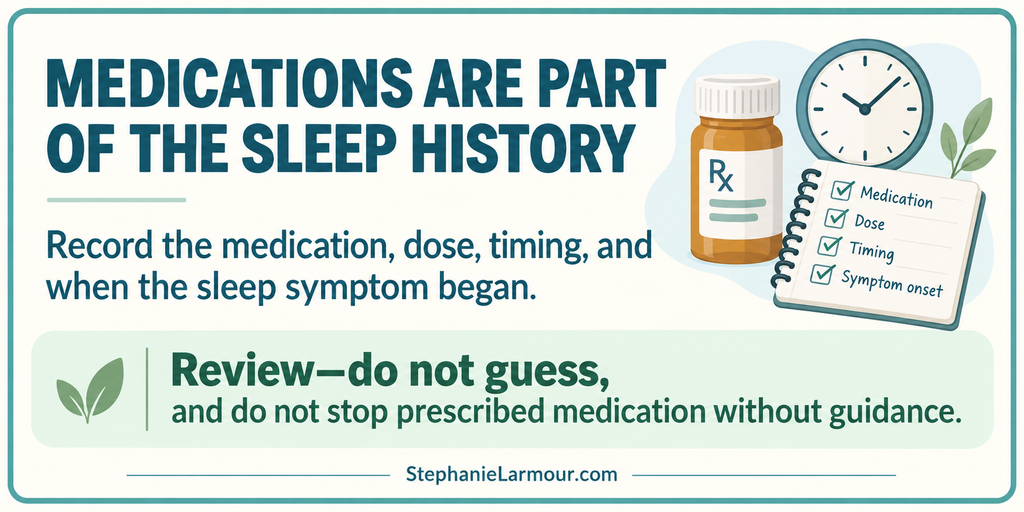
Clue 10: Medications and Supplements
Medications can affect sleep in different ways.
Some may cause:
- Drowsiness
- Insomnia
- Vivid dreams
- Restlessness
- Increased urination
- Reflux
- Breathing suppression
- Changes in sleep architecture
Potentially relevant categories may include:
- Stimulants
- Decongestants
- Corticosteroids
- Some antidepressants
- Some blood-pressure medications
- Diuretics
- Thyroid medication
- Sedatives
- Opioid pain medications
- Certain antihistamines
- Supplements marketed for energy or weight loss
This does not mean a needed medication should be stopped.
Instead, ask:
- Did the sleep problem begin after starting or changing a medication?
- Does medication timing correspond with symptoms?
- Could two products contain similar stimulating ingredients?
- Is a nighttime medication causing morning grogginess?
- Could a medication be worsening restless legs or breathing?
Review medications and supplements with a pharmacist or prescribing healthcare professional.
Do not stop prescription medications abruptly without medical guidance.
Environmental Clues Matter Too
Not every interruption comes from inside the body.
Sleep may be affected by:
- Room temperature
- Light
- Noise
- Pets
- A partner’s snoring
- An uncomfortable mattress or pillow
- Phone notifications
- Television
- Caregiving responsibilities
- Safety concerns
- Shift work
The goal is not to create a perfect bedroom.
It is to identify modifiable conditions that repeatedly interfere with sleep.
How Aging Changes Sleep
Sleep architecture changes across the lifespan.
Compared with younger adults, older adults often experience:
- Less N3 slow-wave sleep
- More time in lighter sleep
- More nighttime awakenings
- Earlier evening sleepiness
- Earlier morning waking
- Reduced sleep efficiency
- Greater sensitivity to pain, noise, and temperature
Age-related changes are real, but poor sleep should not automatically be dismissed as normal aging.
Sleep disorders, health conditions, medications, pain, nocturia, and mood changes become more common with age and may contribute to sleep disruption.[12–14]
The question is not:
“Why can’t I sleep like I did when I was 20?”
A more useful question is:
“Which parts of my current sleep pattern may be expected, and which clues deserve investigation?”
What Can a Sleep Tracker Tell You?
Consumer sleep trackers may estimate:
- Total sleep time
- Bedtime and wake time
- Nighttime movement
- Heart rate
- Heart-rate variability
- Breathing patterns
- Estimated sleep stages
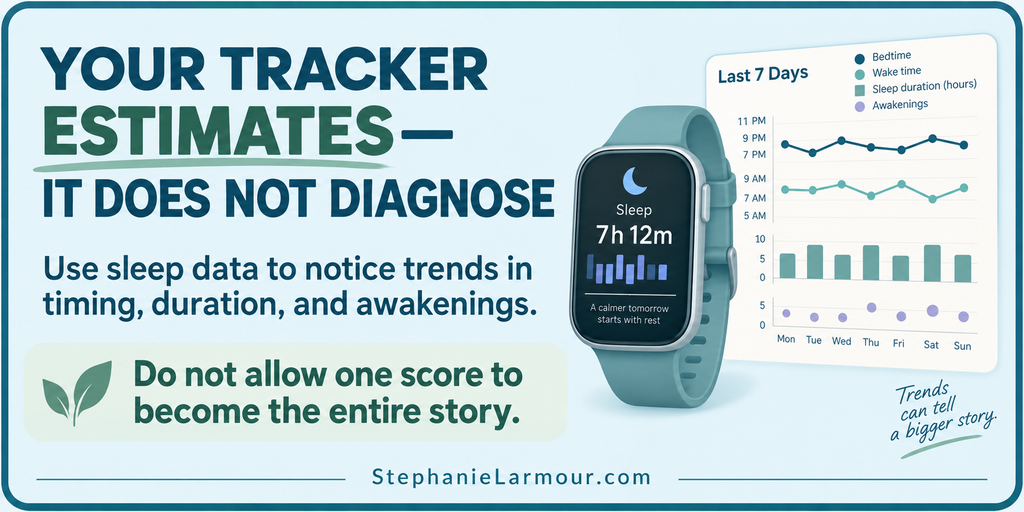
These devices can be useful for identifying trends.
However, most watches and rings do not directly measure brain waves. Their sleep-stage estimates may differ from clinical polysomnography.
Consumer sleep technology should not be used by itself to diagnose or treat a sleep disorder.[15]
Useful tracker questions include:
- Is my sleep schedule consistent?
- Does alcohol correspond with more awakenings?
- Does late caffeine correspond with shorter sleep?
- Am I allowing enough time in bed?
- Is a pattern repeating over several weeks?
Less useful questions include:
- Why was my deep sleep low last night?
- How do I force my score to become perfect?
- Does this one number mean I have a disease?
Becoming preoccupied with sleep data can itself increase anxiety. This has been described as orthosomnia—an unhealthy pursuit of perfect tracker-defined sleep.[16]
Use the tracker as a clue, not a verdict.
The Seven-Day Sleep Detective Challenge
For seven days, record only enough information to identify patterns.
Do not turn the journal into another source of stress.
Morning Questions
Record:
- Approximate bedtime
- Approximate wake time
- Number of awakenings you remember
- How rested you feel from 1–10
- Morning headache or dry mouth
- Daytime sleepiness
- Any unusual overnight symptoms
Evening Questions
Record:
- Last caffeine and approximate amount
- Alcohol
- Meal timing
- Medications and supplements
- Exercise or movement
- Stress level
- Pain level
- Hot flashes or night sweats
- Restless-leg symptoms
Interruption Questions
Ask:
- What woke me?
- Was it the same clue as another night?
- Could I return to sleep?
- Was the awakening associated with breathing, movement, pain, heat, reflux, urination, worry, noise, or another factor?
At the end of seven days, look for connections.
Examples might include:
- More awakenings after alcohol
- Restless legs on several evenings
- Reflux after late meals
- Hot flashes followed by prolonged wakefulness
- Morning headaches with loud snoring
- Better sleep when caffeine ends earlier
- Frequent urination on nights with more evening fluids
An observation is not a diagnosis. It is information that can help you ask a better question.
Practical Ways to Support Sleep Continuity
Keep a Reasonably Consistent Schedule
A consistent waking time helps anchor the circadian rhythm.
Seek Morning Light
Morning outdoor light helps communicate to the brain that the active portion of the day has begun.
Move Caffeine Earlier
If sleep is fragmented, experiment with moving caffeine earlier rather than assuming it has no effect.
Question Alcohol as a Sleep Aid
Feeling sleepy after alcohol is not the same as experiencing healthy sleep architecture.
Create a Wind-Down Transition
Dim lights and reduce work, upsetting media, and activating conversations close to bedtime when possible.
Support a Comfortable Environment
Adjust:
- Temperature
- Light
- Noise
- Bedding
- Phone notifications
Avoid Heavy Meals Immediately Before Bed
This may be particularly helpful for people who experience reflux.
Address the Physical Clue
A relaxing bedtime routine cannot correct an obstructed airway, iron-related restless legs, uncontrolled pain, or another untreated medical condition.
Sleep hygiene is useful. It is not a substitute for appropriate evaluation.
When Should Sleep Symptoms Be Evaluated?
Speak with a healthcare professional when sleep problems are persistent, worsening, or interfering with daily functioning.
Important clues include:
- Loud, frequent snoring
- Breathing pauses
- Gasping or choking during sleep
- Falling asleep unintentionally during the day
- Sleepiness while driving
- Morning headaches
- Persistent insomnia
- Strong nighttime urges to move the legs
- Frequent kicking or limb movements
- New or drenching night sweats
- Repeated nighttime urination
- Persistent reflux
- Worsening pain
- Confusion or unusual nighttime behaviors
- Significant changes in memory or concentration
Urgent evaluation is appropriate for severe breathing difficulty, chest pain, new neurological symptoms, thoughts of self-harm, or sleepiness that makes driving unsafe.
Stephanie Says
Sleep Continuity Is a Clue
Final Review of the Sleep Detective Series
Across these three articles, we followed three connected clues.
Article 1: Understand the Sequence
Sleep moves through N1, N2, N3, and REM.
The whole night matters.
Article 2: Understand the Evidence
NREM sleep supports distinctive brain-fluid movement, but “brain detox” is an oversimplification.
Follow the evidence rather than a magical clock window.
Article 3: Investigate the Interruptions
Time in bed does not always equal restorative sleep.
Breathing, movement, pain, temperature, reflux, urination, substances, medications, stress, and the environment may all provide clues.
The goal is not to create perfect sleep.
The goal is to understand your pattern well enough to ask the next useful question.
References
- Fultz NE, Bonmassar G, Setsompop K, et al. Coupled electrophysiological, hemodynamic, and cerebrospinal fluid oscillations in human sleep. Science. 2019;366(6465):628–631.
https://www.science.org/doi/10.1126/science.aax5440 - National Heart, Lung, and Blood Institute. Sleep apnea. Updated January 9, 2025.
https://www.nhlbi.nih.gov/health/sleep-apnea - National Heart, Lung, and Blood Institute. Sleep apnea symptoms. Updated January 9, 2025.
https://www.nhlbi.nih.gov/health/sleep-apnea/symptoms - Joseph V, Nagalli S. Periodic Limb Movement Disorder. StatPearls. Updated 2023.
https://www.ncbi.nlm.nih.gov/books/NBK560727/ - Hornyak M, Feige B, Riemann D, Voderholzer U. Periodic leg movements in sleep and periodic limb movement disorder: prevalence, clinical significance and treatment. Sleep Medicine Reviews. 2006;10(3):169–177.
https://pubmed.ncbi.nlm.nih.gov/16762807/ - Baker FC, Lampio L, Saaresranta T, Polo-Kantola P. Sleep and sleep disorders in the menopausal transition. Sleep Medicine Clinics. 2018;13(3):443–456.
https://pmc.ncbi.nlm.nih.gov/articles/PMC6092036/ - Jung HK, Choung RS, Talley NJ. Gastroesophageal reflux disease and sleep disorders: evidence for a causal link and therapeutic implications. Journal of Neurogastroenterology and Motility. 2010;16(1):22–29.
https://pmc.ncbi.nlm.nih.gov/articles/PMC2879818/ - Leslie SW, Sajjad H, Singh S. Nocturia. StatPearls. Updated 2024.
https://www.ncbi.nlm.nih.gov/books/NBK518987/ - Drake C, Roehrs T, Shambroom J, Roth T. Caffeine effects on sleep taken 0, 3, or 6 hours before going to bed. Journal of Clinical Sleep Medicine. 2013;9(11):1195–1200.
https://pmc.ncbi.nlm.nih.gov/articles/PMC3805807/ - Gardiner CL, Weakley J, Burke LM, et al. The effect of caffeine on subsequent sleep: a systematic review and meta-analysis. Sleep Medicine Reviews. 2023;69:101764.
https://pubmed.ncbi.nlm.nih.gov/36870101/ - Colrain IM, Nicholas CL, Baker FC. Alcohol and the sleeping brain. Handbook of Clinical Neurology. 2014;125:415–431.
https://pmc.ncbi.nlm.nih.gov/articles/PMC5821259/ - Li J, Vitiello MV, Gooneratne NS. Sleep in normal aging. Sleep Medicine Clinics. 2018;13(1):1–11.
https://pmc.ncbi.nlm.nih.gov/articles/PMC5841578/ - Miner B, Kryger MH. Sleep in the aging population. Sleep Medicine Clinics. 2017;12(1):31–38.
https://pmc.ncbi.nlm.nih.gov/articles/PMC5300306/ - Taillard J, Gronfier C, Bioulac S, Philip P, Sagaspe P. Sleep in normal aging, homeostatic and circadian regulation and vulnerability to sleep deprivation. Brain Sciences. 2021;11(8):1003.
https://pmc.ncbi.nlm.nih.gov/articles/PMC8392749/ - Khosla S, Deak MC, Gault D, et al. Consumer sleep technology: an American Academy of Sleep Medicine position statement. Journal of Clinical Sleep Medicine. 2018;14(5):877–880.
https://jcsm.aasm.org/doi/10.5664/jcsm.7128 - Baron KG, Abbott S, Jao N, Manalo N, Mullen R. Orthosomnia: are some patients taking the quantified self too far? Journal of Clinical Sleep Medicine. 2017;13(2):351–354.
https://jcsm.aasm.org/doi/10.5664/jcsm.6472
This article is intended for general education and is not a substitute for individualized medical evaluation, diagnosis, or treatment. Persistent, worsening, or concerning sleep symptoms should be discussed with a qualified healthcare professional.
Write Reviews
Leave a Comment
No Comments & Reviews