22 Oct, 2026 | Stephanie Sanders | No Comments
What Does Current Research Tell Us how to minimize nutrient loss when cooking?
Stephanie Larmour Sanders MSRD, CDE, FNLP
Anti-inflammatory Dietition Nutritionist
Research published in 2024 and 2025 reinforces an important point: we cannot simply divide foods into “raw equals nutritious” and “cooked equals nutrient loss.”
A comprehensive 2024 review examined how thermal processing affects polyphenols, carotenoids, glucosinolates, and vitamin C in fruits and vegetables. The researchers found that heating can either increase or decrease bioactive compounds depending on the food, plant tissue, temperature, cooking time, and method. They also emphasized something especially important: the amount of a compound present in a food is not the same thing as how much becomes accessible and available to the body. In some cases, thermal processing can improve the release and absorption of plant compounds.
Another 2024 review focusing specifically on natural antioxidants concluded that different thermal-processing techniques can substantially influence antioxidant retention, bioaccessibility, and overall food quality.
Flavonoids—a major family of polyphenols—also behave differently from one another when heated. A 2024 scientific review concluded that many flavonoids have relatively low thermal stability, but thermal processing can have either beneficial or detrimental effects depending on the particular compound and food matrix.
Newer Vegetable Research
A 2025 study compared raw, steamed, and sous-vide preparations of beetroot, red cabbage, red and green peppers, and kale.Again, there was no single winner.
Polyphenol content and measured antioxidant activity responded differently depending on the vegetable, cooking temperature, and method. Sous-vide cooking around 80–85°C performed favorably for several measurements, but the response varied among vegetables.
A separate 2025 study of several Brassica vegetables found that short steaming increased measured phytochemical content and antioxidant activity, while the effects depended on steaming duration and the individual vegetable.
This helps explain why nutritional science cannot give us one rule such as:
“Never heat vegetables.” or “Cooking always makes vegetables healthier.”
Neither statement accurately represents the evidence.
What About Extra-Virgin Olive Oil?
Extra-virgin olive oil deserves special attention because it contains naturally occurring phenolic compounds.
A 2024 study heated different varieties of extra-virgin olive oil at 180°C and 220°C, temperatures intended to simulate roasting conditions.
Higher temperatures produced greater losses of phenolic compounds and antioxidant activity.
However, the researchers also found something important:
A meaningful amount of phenolic compounds and antioxidant activity remained after heating.
Different olive varieties also responded differently. That gives us another useful clue.
Heat can reduce some of the beneficial compounds in extra-virgin olive oil, but that does not mean heated olive oil suddenly loses all nutritional value.
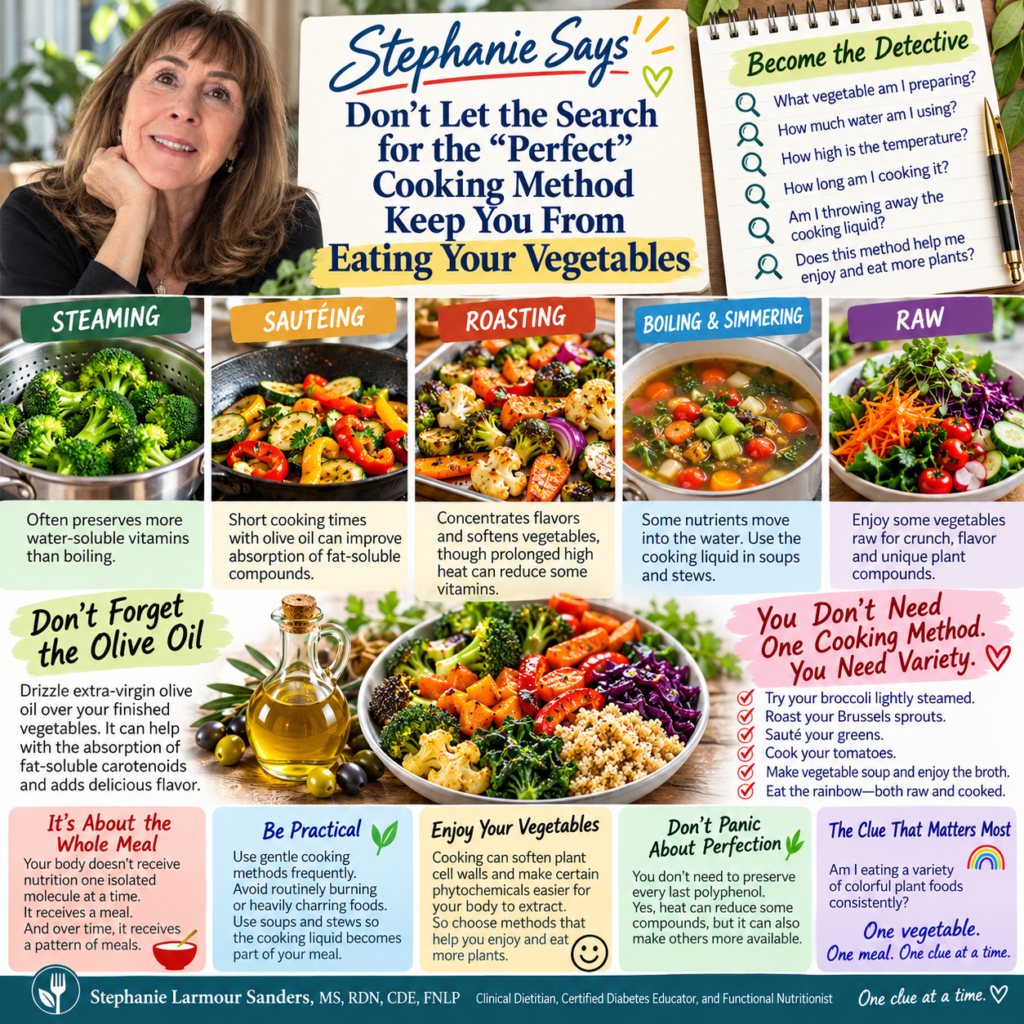
One practical strategy is to use extra-virgin olive oil appropriately in cooking while also enjoying some uncooked—drizzled over vegetables, beans, salads, soups, or other finished foods.
🔎 Stephanie Says
Write Reviews
Leave a Comment
No Comments & Reviews