
2 Sep, 2026 | Stephanie | No Comments
Sleep Architecture: What Your Brain and Body Do Throughout the Night
Article 1 of 3 in the Sleep Detective Series
Stephanie Larmour Sanders, MS, RDN, CDE, FNLP
Clinical Dietitian, Certified Diabetes Educator, and Functional Nutritionist
Sleep and Overnight Restoration
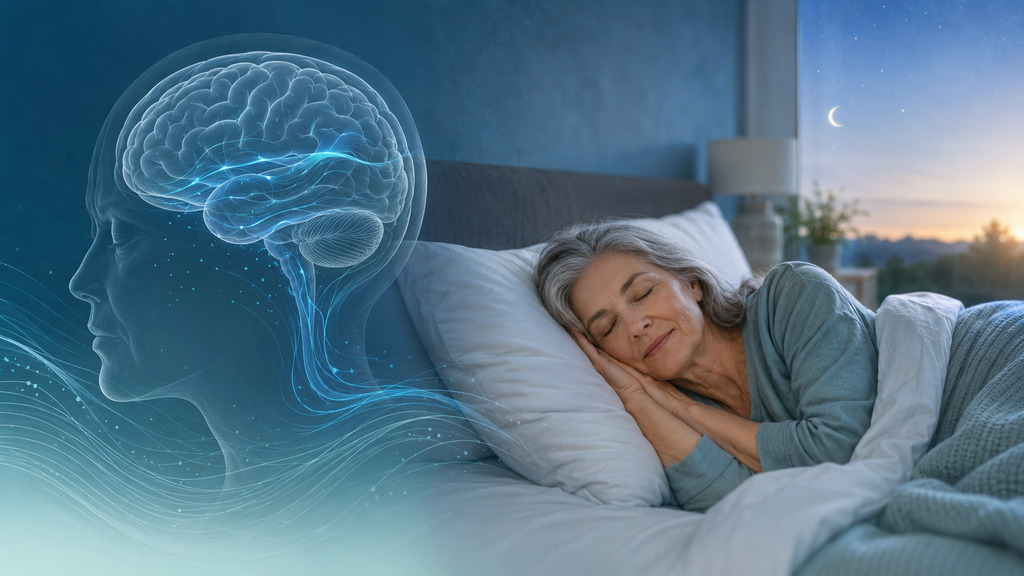
Sleep is not an inactive state. Throughout the night, the brain and body move through a carefully organized series of restorative stages. Educational illustration of the brain during sleep, read on.
Sleep Is Not Empty Time
We often talk about sleep as though the brain and body simply switch off for the night. But sleep is not an inactive state.
While we sleep, the brain moves through a carefully organized series of stages. Each stage supports different aspects of physical restoration, memory, learning, emotional regulation, immune function, metabolism, and brain health.
This nightly pattern is called sleep architecture. Understanding sleep architecture can help explain why:
- Seven or eight hours in bed may not always feel restorative.
- Repeated awakenings can leave someone tired the next day.
- Cutting the night short affects more than total sleep time.
- Deep sleep and REM sleep are both important.
- One poor sleep score does not tell the entire story.
The body leaves clues during the day and during the night. Learning how normal sleep is organized gives us a foundation for recognizing when that pattern may be interrupted.
What Is Sleep Architecture?
Sleep architecture describes the structure and organization of sleep throughout the night.
Sleep is divided into two major categories:
- NREM sleep: Non-rapid eye movement sleep
- REM sleep: Rapid eye movement sleep
NREM sleep is divided into three stages:
- N1: The transition from wakefulness into sleep
- N2: Stable, light-to-moderate sleep
- N3: Deep or slow-wave sleep
A typical sleep cycle progresses approximately like this:
Wake → N1 → N2 → N3 → N2 → REM → Repeat
The pattern is not perfectly identical during every cycle. The amount of time spent in each stage changes as the night progresses.
One complete sleep cycle generally lasts approximately 90–110 minutes, although timing varies from person to person and from one cycle to another.[1–3]
Most adults complete approximately four to six sleep cycles during a full night of sleep.
How Sleep Architecture Changes Through the Night
“What Is Sleep Architecture?”
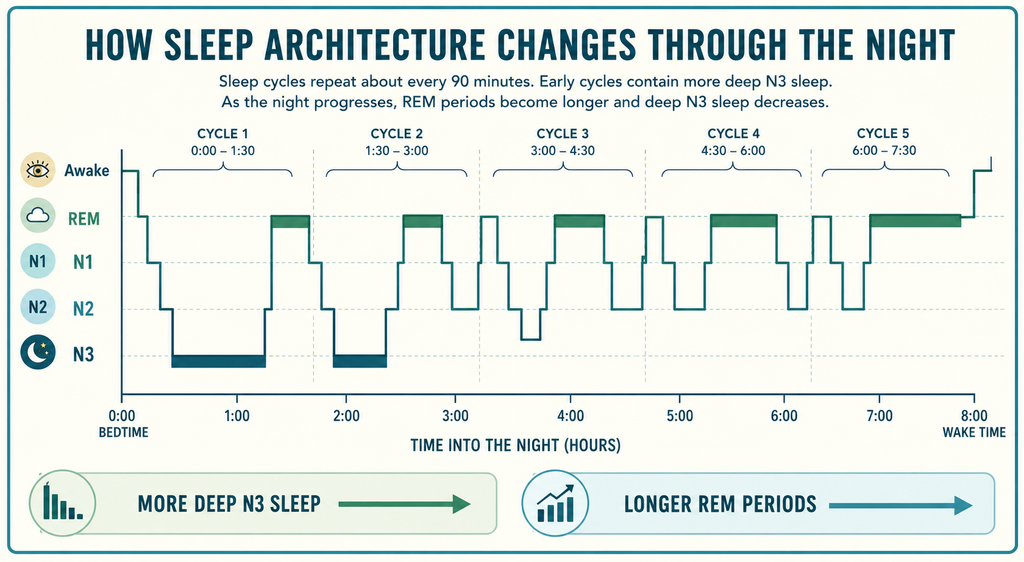
Deep N3 sleep is more abundant in the earlier sleep cycles. REM periods become progressively longer during the later cycles.
Sleep-architecture chart showing repeated N1, N2, N3, and REM cycles, with more deep sleep early and longer REM periods later.
Sleep Does Not Follow the Same Pattern All Night
Sleep architecture changes as the night progresses.
During the first third to first half of the sleep period, the brain generally spends more time in deep N3 sleep.
During the second half of the sleep period, deep sleep decreases and REM periods become longer.[1,2]
A useful way to think about the night is:
Earlier sleep cycles → More deep N3 sleep
Later sleep cycles → Longer REM periods
Both parts of the night matter.
Obtaining several hours of sleep early in the night may provide some deep sleep, but cutting the night short can disproportionately remove the later REM-rich cycles.
The goal is not to obtain only one kind of sleep.
The goal is to give the brain enough time to move through the entire sequence.
The Four Main Stages of Sleep
N1: Entering Sleep
N1 is the lightest stage of sleep.
It is the brief transition between being awake and being asleep.
During N1:
- Muscles begin to relax.
- Eye movements slow.
- Awareness of the environment decreases.
- Brain-wave activity begins to change.
- A person can be awakened easily.
- Sudden muscle movements may occur.
- Some people experience a sensation of falling.
N1 normally represents only a small portion of total sleep time.
If sleep is repeatedly interrupted, however, a person may return to N1 more frequently and spend less continuous time in the deeper stages.
N1 is the doorway into sleep—but the brain is not meant to remain at the doorway all night.
N2: Stable Sleep
N2 is generally the most abundant sleep stage in healthy adults.[2,3]
During N2:
- Heart rate slows.
- Breathing becomes more regular.
- Body temperature decreases.
- Eye movements stop.
- Awareness of the environment continues to fade.
- Muscle activity decreases.
- The brain produces sleep spindles and K-complexes.
What Are Sleep Spindles?
Sleep spindles are brief bursts of rapid electrical activity in the brain.
They are thought to contribute to:
- Sleep stability
- Memory processing
- Learning
- Protection from unnecessary awakening
What Are K-Complexes?
K-complexes are large electrical-wave patterns that occur during N2 sleep.
They may help the sleeping brain evaluate environmental information without fully awakening.
For example, the brain may respond differently to an insignificant background sound than it would to a potentially meaningful sound. N2 is sometimes called light sleep, but “light” does not mean unimportant. It occupies a large portion of the night and helps maintain sleep while supporting memory and sensory processing.
N3: Deep, Slow-Wave Sleep
N3 is the deepest stage of NREM sleep.
It is also called:
- Deep sleep
- Slow-wave sleep
- Delta sleep
During N3, the brain produces large, slow electrical waves called delta waves. It is generally more difficult to awaken someone from this stage.
If a person is awakened suddenly from deep sleep, they may briefly feel confused or disoriented. This is sometimes called sleep inertia.
N3 sleep is associated with:
- Physical restoration
- Tissue repair
- Growth-hormone secretion
- Immune regulation
- Energy conservation
- Memory consolidation
- Nervous-system recovery
- Distinctive cerebrospinal-fluid and vascular activity
Deep sleep is normally concentrated during the first several sleep cycles.[1–3]. This does not mean that deep sleep always occurs between the same clock hours for everyone. A person who falls asleep at 9:30 PM will begin their first cycles at a different clock time from someone who falls asleep at midnight.
The timing of deep sleep is related to:
- When sleep begins
- How long the person was awake beforehand
- Circadian timing
- Age
- Sleep deprivation
- Health conditions
- Medications and substances
- Whether sleep is repeatedly interrupted
Deep sleep is important, but it is only one part of healthy sleep architecture.
REM: The Active-Brain Stage
REM stands for rapid eye movement sleep.
During REM sleep:
- Brain activity becomes more similar to wakefulness.
- Rapid eye movements occur.
- Vivid dreaming is common.
- Heart rate and breathing may become more variable.
- Most skeletal muscles become temporarily inactive.
This temporary muscle inactivity helps prevent the body from acting out most dreams.
REM sleep supports:
- Emotional processing
- Learning
- Memory integration
- Adaptation to stressful experiences
- Creativity and problem-solving
The first REM period is usually relatively brief.
As the night progresses, REM periods become longer. This means that the final hours of sleep can contain a significant portion of the night’s REM sleep.[1,2]
Cutting sleep short may therefore affect emotional regulation, concentration, and memory—even if the person obtained some deep sleep earlier.
Which Stage Is the Most Restorative?
It is tempting to ask which sleep stage is the “best.”
The answer depends on what we mean by restorative.
N3 Supports Physical Restoration
Deep N3 sleep is strongly associated with:
- Physical recovery
- Immune regulation
- Tissue repair
- Growth-hormone secretion
- Slow-wave brain activity
REM Supports Emotional and Cognitive Processing
REM sleep contributes to:
- Emotional regulation
- Memory integration
- Learning
- Adaptation
- Creative processing
N2 Supports Sleep Stability and Memory
N2 helps:
- Maintain sleep
- Process sensory information
- Support learning
- Consolidate certain memories
N1 Allows the Transition Into Sleep
N1 creates the transition from wakefulness into the more stable stages of sleep.
Rather than searching for one perfect stage, think of the night as a team of specialized workers.
Each stage has a different job.
Healthy sleep depends on the sequence—not just one stage.
Is There a Universal 10:00 PM–2:00 AM Restorative Window?
Not exactly. For someone who falls asleep around 10:00 PM, a significant portion of that person’s deep sleep may occur between approximately 10:00 PM and 2:00 AM. But those clock hours are not a universal restorative or “detox” window. Deep sleep is generally concentrated in the first several sleep cycles—whenever those cycles begin.
Circadian timing still matters. Consistently sleeping at a time that conflicts with the body’s biological rhythm may affect sleep quality and architecture.
But the more useful questions are:
- When do I usually fall asleep?
- Is my schedule reasonably consistent?
- Am I allowing enough time for a full night?
- Do I wake repeatedly?
- Am I cutting off my later REM-rich sleep?
- Do I feel restored when I awaken?
The detective looks beyond one clock time.
The detective looks for the pattern.
Why the Whole Night Matters
The early and later portions of sleep are not interchangeable. The first part of the sleep period is usually richer in deep N3 sleep. The later portion contains longer REM periods. If someone sleeps only four or five hours, they may obtain some early deep sleep but lose much of the later REM-rich portion. This is why sleep duration matters in addition to sleep depth. Most healthy adults are advised to obtain at least seven hours of sleep regularly, with many adults needing approximately seven to nine hours.[4] Individual needs vary, but repeatedly cutting sleep short may interfere with the brain’s opportunity to complete its normal architecture.
The question is not only:
“Did I get deep sleep?”
It is also:
“Did I give my brain enough time to complete the entire night’s work?”
Brief Awakenings Can Be Normal
Most people do not move through the night without any awakenings.
Brief awakenings may occur:
- Between sleep cycles
- After a sound
- When changing position
- In response to temperature
- Near the end of a REM period
Many brief awakenings are not remembered the next morning.
The concern is not necessarily whether a person awakens at all.
More important questions include:
- How often am I awakening?
- How long am I awake?
- Can I return to sleep?
- Is there a repeating physical trigger?
- Do the awakenings leave me tired during the day?
Repeated or prolonged awakenings may prevent the brain from progressing normally through its sleep stages.
We will investigate fragmented sleep more closely in Article 3 of this series.
How Sleep Architecture Changes With Age
Sleep patterns change across the lifespan.
Children and adolescents generally obtain more deep sleep than older adults.
As adults age, they may experience:
- Less N3 deep sleep
- More time in lighter sleep
- More nighttime awakenings
- Earlier sleep and waking times
- Reduced sleep efficiency
- Greater sensitivity to noise, discomfort, and temperature
These changes do not mean that every sleep problem should be dismissed as normal aging.
Persistent snoring, gasping, restless legs, pain, night sweats, excessive daytime sleepiness, or frequent awakenings may indicate that something is interfering with sleep architecture.
Aging changes the clues. It does not eliminate the need to investigate them.
What Your Sleep Tracker Can—and Cannot—Tell You
Consumer watches and rings can estimate sleep stages by analyzing signals such as:
- Movement
- Heart rate
- Heart-rate variability
- Breathing patterns
- Skin temperature
Most consumer trackers do not directly measure electrical brain-wave activity.
Their estimates of N1, N2, N3, and REM may differ from measurements obtained through clinical polysomnography.
A sleep tracker may still help identify trends, including:
- Changes in total sleep time
- Repeated nighttime awakenings
- Differences after alcohol
- Differences after late caffeine
- Changes associated with stress or pain
- Consistently low sleep efficiency
Do not allow one night’s sleep score to create panic.
The device offers estimates—not a diagnosis. Use the information as a clue and look for patterns over time.
A Simple Sleep-Architecture Detective Check
Consider these questions for one week:
Sleep Timing
- What time did I go to bed?
- Approximately what time did I fall asleep?
- What time did I awaken?
- Was my schedule different from the previous night?
Sleep Continuity
- How many awakenings do I remember?
- Was I able to return to sleep?
- Did pain, temperature, noise, urination, or leg discomfort awaken me?
Evening Clues
- Did I consume caffeine late in the day?
- Did I drink alcohol?
- Was I working or using bright screens close to bedtime?
- Was I especially worried or mentally stimulated?
Morning Clues
- Did I awaken feeling restored?
- Did I have a morning headache?
- Was my mouth unusually dry?
- Did I feel sleepy or mentally foggy during the day?
You do not need to monitor every detail forever. The purpose is to notice whether a pattern begins to emerge.
“How many hours was I in bed?”
Ask:
- Did I give myself enough time to complete several sleep cycles?
- Did I wake repeatedly?
- Am I cutting my sleep short?
- Do I feel restored in the morning?
- What patterns am I beginning to notice?
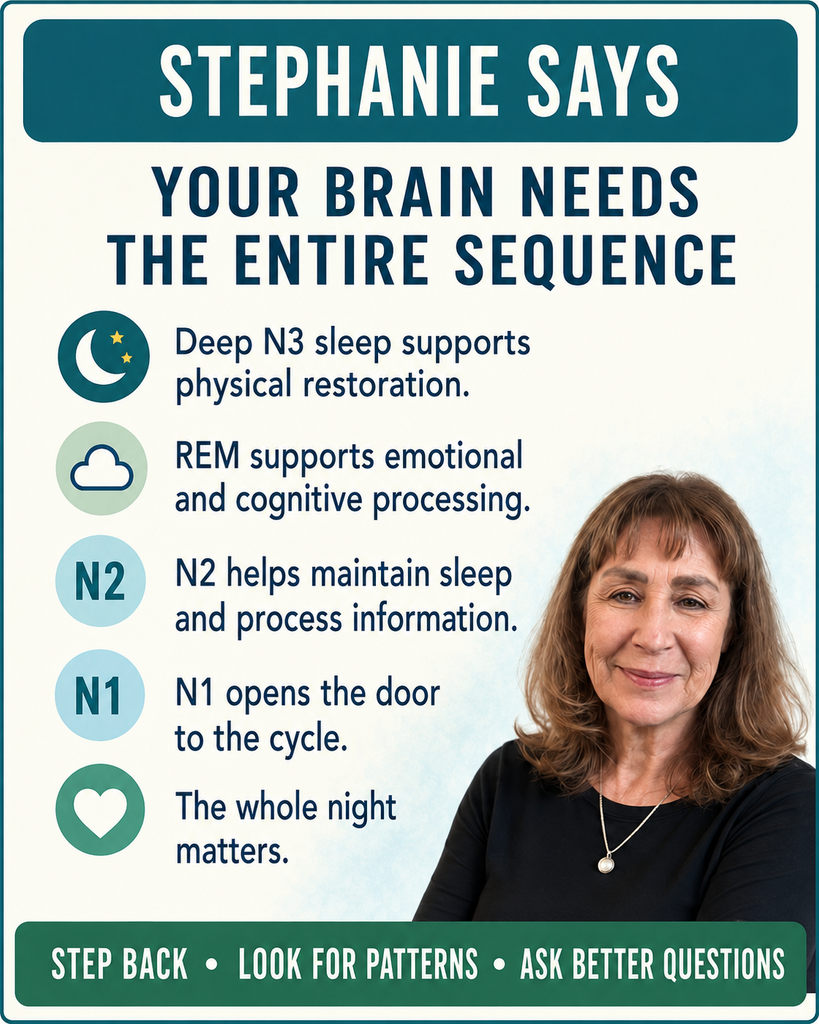
Do not panic over every sleep score.
Step back.
Look for patterns.
Ask better questions.
Symptoms are clues. Patterns are information. One clue at a time.
Continue the Sleep Detective Series
In Article 2, we will look more closely at deep N3 sleep and the brain’s glymphatic system.
We will investigate:
- How cerebrospinal fluid moves around the brain
- What researchers mean by metabolic-waste clearance
- Whether sleep truly “detoxes” the brain
- What the evidence shows about amyloid-beta and tau
- Why there is no universal 10:00 PM–2:00 AM detox window
References
- National Heart, Lung, and Blood Institute. Sleep phases and stages. National Institutes of Health. Updated March 24, 2022.
https://www.nhlbi.nih.gov/health/sleep/stages-of-sleep - Patel AK, Reddy V, Shumway KR, Araujo JF. Physiology, Sleep Stages. StatPearls. StatPearls Publishing; updated 2024.
https://www.ncbi.nlm.nih.gov/books/NBK526132/ - Shrivastava D, Jung S, Saadat M, Sirohi R, Crewson K. How to interpret the results of a sleep study. Journal of Community Hospital Internal Medicine Perspectives. 2014;4(5):24983.
https://pmc.ncbi.nlm.nih.gov/articles/PMC4246141/ - Watson NF, Badr MS, Belenky G, et al. Recommended amount of sleep for a healthy adult: A joint consensus recommendation of the American Academy of Sleep Medicine and Sleep Research Society. Sleep. 2015;38(6):843–844.
https://doi.org/10.5665/sleep.4716
This article is intended for general education and is not a substitute for individualized medical evaluation, diagnosis, or treatment. Persistent or concerning sleep symptoms should be discussed with a qualified healthcare professional.
Write Reviews
Leave a Comment
No Comments & Reviews