23 Oct, 2026 | Stephanie Sanders | No Comments
Fiber, Microbial Diversity, and Digestive Health: How to Nourish Your Gut Naturally
By Stephanie Larmour Sanders, MS, RDN, CDE, FNLP
Anti-Inflammatory Dietitian and Nutritionist
Have you ever wondered why two people can eat the same food and have completely different digestive experiences? One person may feel comfortable after a bowl of beans, while another experiences bloating, gas, or abdominal discomfort. Our digestive systems are influenced by many factors, including the foods we eat, medications, health conditions, and the microorganisms living in our intestines.
One important nutritional factor is dietary fiber. Fiber does much more than help keep our bowels regular. Certain types also provide nourishment for beneficial intestinal microorganisms and help support processes involved in digestive and metabolic health. But supporting gut health does not mean eating enormous salads, taking expensive supplements, or following a restrictive diet.
It begins with understanding how fiber works and making realistic changes that your digestive system can tolerate.
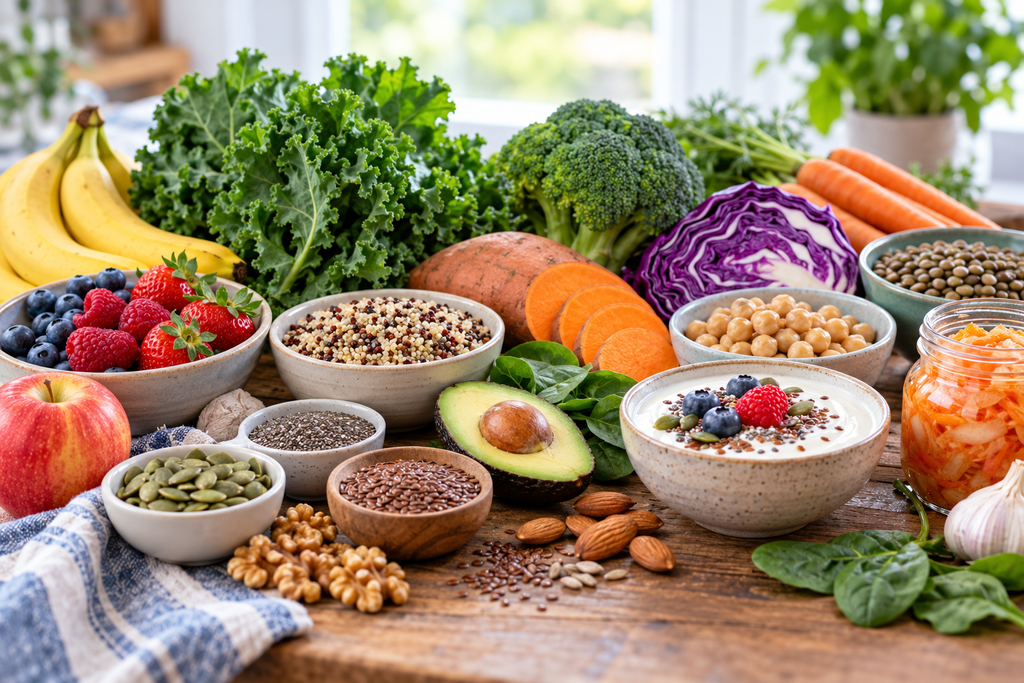
A variety of fiber-rich foods arranged naturally on a kitchen table.
What Is Dietary Fiber?
Dietary fiber is a type of carbohydrate found primarily in plant foods that our digestive enzymes cannot fully break down in the small intestine. Unlike digestible carbohydrates, fiber travels into the large intestine, where it can influence bowel function and, depending on the type, become food for intestinal microorganisms. Fiber is often described in two broad categories.
Soluble Fiber
Soluble fiber dissolves or swells in water. Some forms create a gel-like consistency that may help slow digestion, support cholesterol management, and moderate blood sugar responses.
Good sources include:
- Oats and barley
- Beans and lentils
- Apples and citrus fruits
- Psyllium
- Certain vegetables
Insoluble Fiber
Insoluble fiber generally does not dissolve in water. It can help add bulk to stool and support regular bowel movements.
Sources include:
- Whole grains
- Wheat bran
- Nuts and seeds
- Vegetable skins
- Many vegetables
These categories are useful, but they do not tell the whole story. Another important characteristic is whether a particular fiber can be fermented by gut microorganisms. Most plant foods contain a combination of fiber types, which is one reason variety can be helpful.
Meet Your Gut Microbiome
Your digestive tract is home to a complex community of bacteria, fungi, viruses, and other microorganisms. Together, these microorganisms and their genetic material are called the gut microbiome. Some microorganisms help break down food components that our own digestive enzymes cannot process. Others participate in the production of metabolites, interact with the intestinal lining, and communicate with the immune system.
Researchers are continuing to explore how these activities influence human health.
What Does Microbial Diversity Mean?
Microbial diversity refers to the variety and distribution of microorganisms living within a community.
Think of a garden.
A garden containing several different plants may have a different balance of organisms and functions than a garden growing only one type of plant. Our intestinal ecosystem is also complex.
However, more microbial diversity is not automatically better in every situation. The types of organisms present, what they do, and the person’s health circumstances all matter. There is no single ideal microbiome composition that applies to everyone.
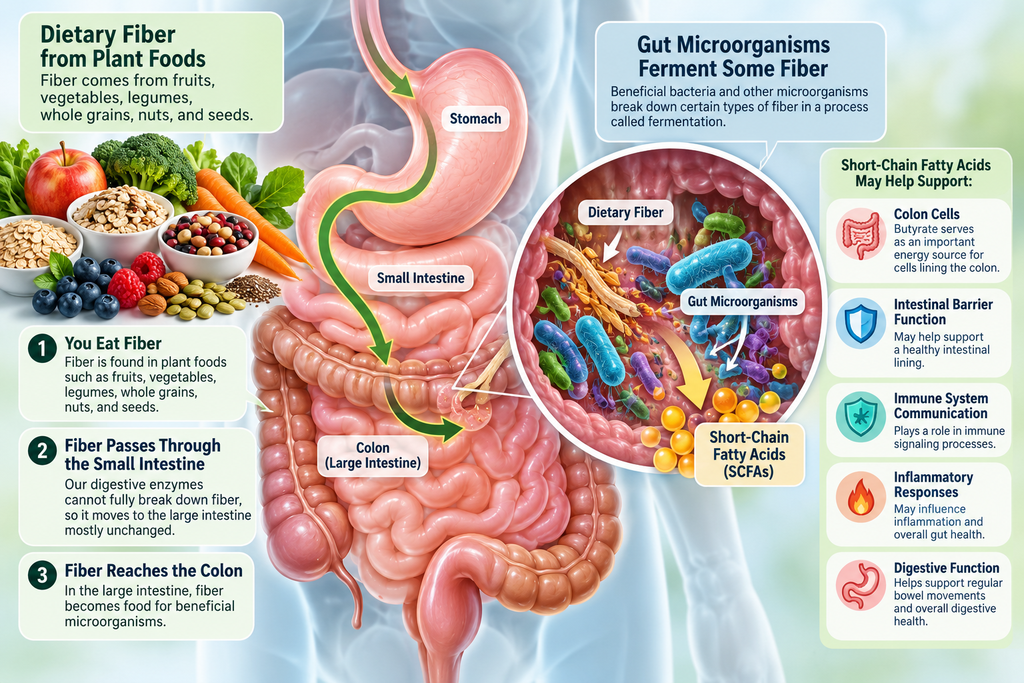
Educational diagram showing dietary fiber traveling to the colon, where microorganisms ferment some fiber.
How Does Fiber Nourish Gut Microorganisms?
Some dietary fibers are fermented by microorganisms in the large intestine. During fermentation, microbes break down certain carbohydrates and produce substances called short-chain fatty acids, or SCFAs.
Three commonly studied SCFAs are:
- Acetate
- Propionate
- Butyrate
Butyrate is particularly interesting because it serves as an important energy source for cells lining the colon. Short-chain fatty acids also participate in processes involving intestinal barrier function, metabolism, and immune signaling. This is one reason researchers are interested in the relationship between fiber, gut microorganisms, and inflammation.However, it is important to distinguish biological mechanisms from proven clinical outcomes. Although fermentation can produce SCFAs, eating more fiber does not guarantee that every person will produce more of every SCFA or experience the same health benefits.
Individual responses vary.
🔬 What Does Research Tell Us About Fiber and Microbial Diversity?
Research supports a relationship between dietary fiber and the composition and activity of intestinal microorganisms.
A systematic review and meta-analysis of 64 studies involving 2,099 participants found that fiber interventions increased certain bacterial groups, including Bifidobacterium and Lactobacillus. However, the analysis did not find a consistent increase in overall microbial diversity.
This is an important distinction.
Fiber can influence the microbiome without necessarily increasing every measure of microbial diversity.
Another systematic review published in 2022 examined fiber interventions and short-chain fatty acid production. The findings suggested that responses varied depending on the type and amount of fiber, as well as study methods.
What About Eating 30 Different Plants a Week?
You may have heard the recommendation to eat 30 different plant foods each week.This idea gained attention following the American Gut Project, which identified an association between greater plant-food variety and differences in gut microbial communities.
But this was observational research.
It does not establish that everyone needs exactly 30 plants per week or that reaching this number will prevent disease. A more practical message is to increase the variety of plant foods you enjoy and tolerate, without turning eating into another source of stress.
How Much Fiber Do We Need?
The National Institute of Diabetes and Digestive and Kidney Diseases notes that adults generally need approximately 22–34 grams of fiber per day, depending on age and sex. Individual needs vary.
Rather than immediately trying to reach a numerical target, begin by looking at the foods you already eat.
Could you add berries to breakfast?
Would lentils work in a familiar soup?
Could you include another vegetable at dinner?
Small additions can gradually increase your fiber intake without requiring a completely new way of eating.
Fiber-Rich Foods That Support Digestive Health
You do not need unusual or expensive ingredients to increase dietary fiber.
Consider these everyday foods:
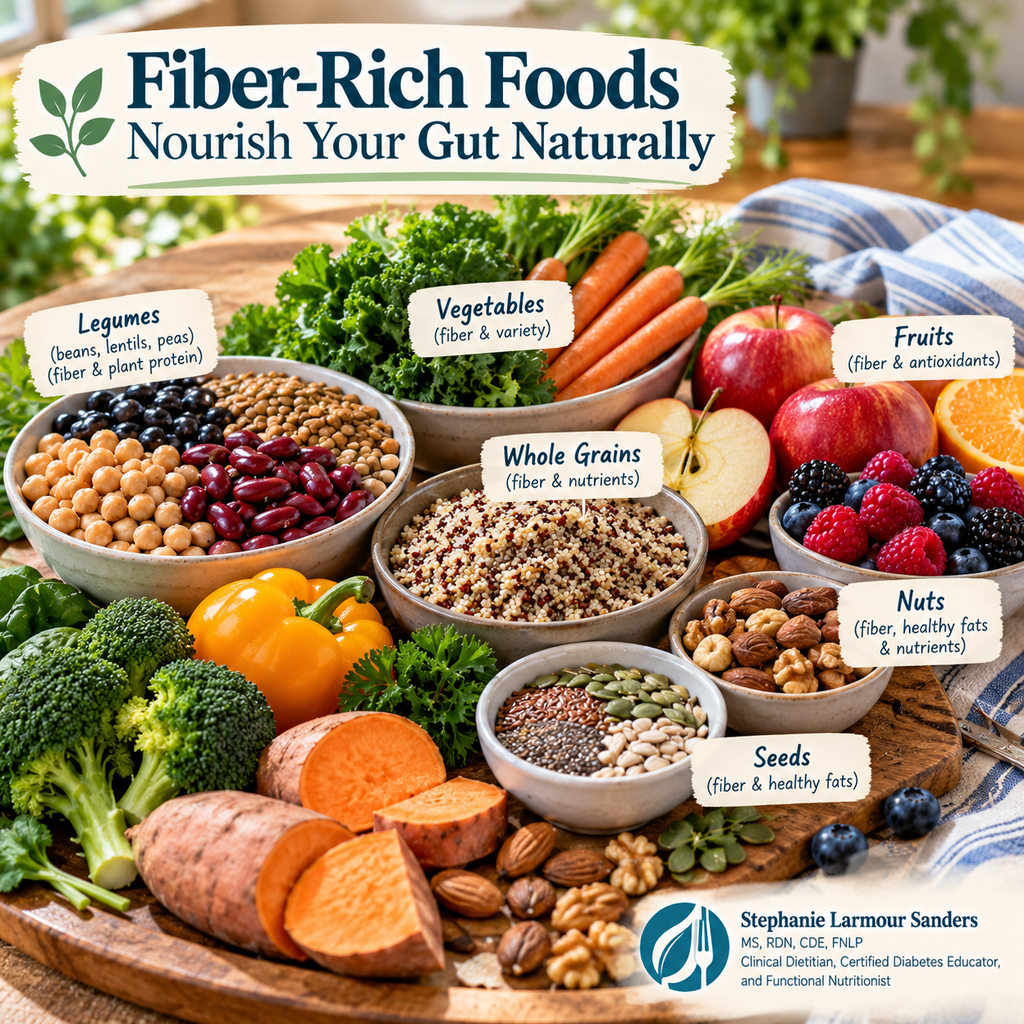
Legumes: Lentils, chickpeas, black beans, kidney beans, and split peas.
Whole grains: Oats, barley, brown rice, quinoa, and whole-wheat products.
Vegetables: Broccoli, carrots, leafy greens, Brussels sprouts, and sweet potatoes.
Fruits: Berries, pears, apples, oranges, and kiwi.
Nuts and seeds: Almonds, walnuts, chia seeds, and ground flaxseed.
Different plant foods provide different combinations of fibers and other nutrients. Variety also makes meals more interesting and enjoyable. Tabletop display of legumes, whole grains, vegetables, fruits, nuts, and seeds.
Why Adding Fiber Too Quickly Can Cause Discomfort
If fiber supports digestive health, why do some people feel worse when they eat more? One explanation is fermentation. When certain fibers reach the colon, intestinal microorganisms ferment them. Gas is a natural byproduct of this process.
A sudden increase in fermentable fiber may contribute to:
- Bloating
- Gas
- Abdominal pressure
- Changes in bowel habits
These symptoms do not automatically mean fiber is harmful or that someone has an unhealthy microbiome.
However, persistent symptoms deserve evaluation rather than simply being attributed to normal fermentation.
A Gentler Way to Increase Fiber
1. Begin with one small addition.
Try adding a modest portion of a fiber-rich food to a meal you already enjoy.
2. Increase gradually.
Allow time to observe your digestive response before making another change.
3. Include adequate fluids.
Water and other appropriate fluids help support normal bowel function. Fluid needs depend on individual health circumstances.
4. Experiment with preparation.
Cooked vegetables, well-cooked lentils, and smaller portions of legumes may be more comfortable for some people than large servings of raw vegetables or beans.
5. Pay attention to patterns.
Notice which foods, portions, and meal combinations feel comfortable.
The goal is not to force your digestive system to tolerate everything immediately.
It is to find a realistic approach that supports nutrition and digestive comfort.
What If You Have IBS or Another Digestive Condition?
More fiber is not always the right immediate recommendation.
People with irritable bowel syndrome, inflammatory bowel disease, intestinal narrowing, gastroparesis, or other digestive conditions may need individualized advice about fiber amount and type. Some people experience greater discomfort with highly fermentable carbohydrates. Others may benefit from specific fibers, such as psyllium, depending on their symptoms and medical history. A temporary low-FODMAP approach may be appropriate for selected individuals with IBS under professional guidance, but it should not become an unnecessarily restrictive long-term diet. Do not assume that persistent bloating means you need to eliminate gluten, dairy, legumes, or entire food groups.
Symptoms are clues, not a diagnosis.
Do You Need a Prebiotic or Probiotic Supplement?
Not necessarily. Prebiotics are substances selectively used by microorganisms in ways that confer a health benefit. Certain dietary fibers qualify as prebiotics, but not every fiber meets that definition. Probiotics are live microorganisms that provide a health benefit when consumed in adequate amounts. Their effects can depend on the specific strain, dose, and condition being studied. For many people, beginning with a varied, balanced eating pattern is a practical first step. Supplements may have a role in particular circumstances, but they are not a universal requirement for gut health.
Discuss supplements with a qualified healthcare professional when you have significant digestive symptoms, medical conditions, or medication concerns.
When Digestive Symptoms Need Medical Attention
Seek medical evaluation for persistent or worsening digestive symptoms, particularly when they interfere with daily life.
Important warning signs include:
- Blood in the stool or rectal bleeding
- Unexplained weight loss
- Persistent or severe abdominal pain
- Repeated vomiting
- Significant changes in bowel habits
- Persistent diarrhea or constipation
- A family history of colorectal cancer or relevant gastrointestinal disease
Severe abdominal pain, especially with vomiting, marked swelling, or inability to pass stool or gas, warrants urgent assessment.
Do not try to manage these symptoms simply by increasing fiber.
Stephanie Says: Start With Variety, Not Perfection

After more than 40 years working in healthcare and nutrition, one lesson continues to guide my teaching:
Small, realistic changes are often easier to sustain than complicated rules. Your practical step this week: Choose one fiber-rich food you enjoy and add it to a familiar meal.
You do not have to change everything at once.
The Bottom Line
Fiber is an important part of digestive health and influences the activity of the gut microbiome.Research continues to explore how these relationships affect inflammation, metabolic health, and long-term wellbeing. We already know that fiber-rich foods can support bowel function and contribute to a nutritious eating pattern. What we are still learning is how different fibers influence individual microbial communities and health outcomes. Rather than chasing a perfect microbiome, focus on nourishing your body consistently.
Symptoms are signals. Patterns are information. And small changes can be a meaningful place to begin.
References
- National Institute of Diabetes and Digestive and Kidney Diseases. Eating, Diet, & Nutrition for Constipation. https://www.niddk.nih.gov/health-information/digestive-diseases/constipation/eating-diet-nutrition
- So D, et al. Dietary fiber intervention on gut microbiota composition in healthy adults: A systematic review and meta-analysis. American Journal of Clinical Nutrition. 2018. https://ajcn.nutrition.org/article/S0002-9165(22)02872-6/fulltext
- Effects of Dietary Fibers on Short-Chain Fatty Acids and Gut Microbiota Composition in Healthy Adults: A Systematic Review. Nutrients. 2022;14(13):2559. https://doi.org/10.3390/nu14132559
- McDonald D, et al. American Gut: An Open Platform for Citizen Science Microbiome Research. mSystems. 2018;3(3). https://doi.org/10.1128/mSystems.00031-18
- National Institute of Diabetes and Digestive and Kidney Diseases. Constipation: Definition, Causes, and Treatment. https://www.niddk.nih.gov/health-information/digestive-diseases/constipation
Educational disclaimer: This article provides general nutrition education and does not replace individualized medical evaluation, diagnosis, or treatment.
Write Reviews
Leave a Comment
No Comments & Reviews